


Playlist: Bookmarks
Rebus Puzzles
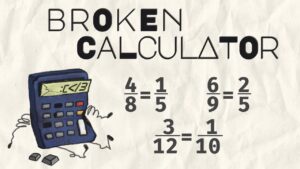
Broken Calculator: Simplifying Fractions
This calculator simplifies fractions with a rule that sometimes works. What is it doing wrong?
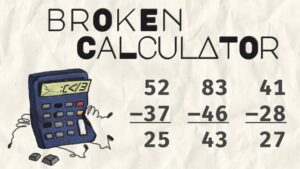
Broken Calculator: 2-Digit Subtraction
This calculator gets subtraction wrong the same way every time. Can your students crack its broken rule?
Earth’s Layers: Who Contributes The Most?
Earth’s layers will disagree about which one contributes the most to the planet’s success.
The Limits of Hands-On Activities
For TeachersMany “hands-on” activities limit students by stopping at a low level of thinking. Here’s how to fix it.
Adding and Subtracting Fruit
Use super cute fruit to introduce algebraic thinking to your young math students.
Contig
Roll three dice and combine them using any mathematical operation. But be strategic to maximize your points!
Founding The Colonies
13 colonies activities including a word search and task cards packed with facts. Plus, students will create their own colony with a name, story, and map!
Summer Activity Pack
A worksheet pack featuring writing prompts, a summer essay project, a science-based escape room activity, and image analysis prompts.

Antagonyms: Dust, Clip, and Left
Dust can mean “remove dust” but also “add more dust!”

Holiday Shuffle – Day vs Date
Wouldn’t some holidays be better on a certain day of the week? Should Thanksgiving have a set date?

Why “Analyze” Is My Favorite Level of Bloom’s Taxonomy
For TeachersAnalyze is like a gateway that connects the lower- and higher-levels of Bloom’s. But make sure you’re truly asking an Analyze-level question!

What’s In My Brain: Pentagon vs Pentagon
We’re looking at regular vs irregular polygons.

A System Similar to a Cell
Which parts of a cell serve a similar job to the parts of a cruise ship, human body, computer, or other system?

What’s In My Brain: Ball vs Book
Let’s look at Kinetic vs Potential Energy!

Thermocryptograph (Greek and Latin)
What on earth is a Thermocryptograph? Break apart the Greek and Latin roots, figure out what it should mean, then invent what it describes.

Aquamorphotron (Greek and Latin)
What on earth is a Aquamorphotron? Break apart the Greek and Latin roots, figure out what it should mean, then invent what it describes.

The Moon – Mixed Up Paragraph
Can you use the context clues to get these sentences about The Moon back into the correct order?

Greekymon Studies – Round 2
What might a creature named “Hypermnemonicus” be like?

Greekymon Studies – Round 1
What might a creature named “Ursolunascope” be like?

Factors and Codes (Episode 1)
Let’s use factors to encode and decode words.

Crossing Every Bridge Exactly Once (aka Eulerian Paths)
How can you cross each bridge in this city exactly once?

Polar Weather Report
The North Pole hits -40°. The South Pole hits -60°. Calculate the averages, graph the data, and deliver your polar weather report.

Van Gogh Self-Portrait Tournament
Who will win the tournament of Van Gogh self-portraits!?

Slow Motion Popcorn
What surprises can you spot when a kernel pops in super slow-mo?

Melting Ice Cream
Various desserts melt in surprisingly different ways.

Bobbing for Apples
What is bobbing for apples like… for an apple?

Going Beyond “Name That Genre!”
For TeachersNaming the genre is step one. But what comes after that? Here’s how to push students past identification into real analysis.

Updating Old Questions: Conflict and Character Change
For TeachersI update an old question about conflict and character change in the story Hatchet.

Super Specific Similes – Slimy Broccoli
Start with a basic simile. Now make it more specific. Now even more. Watch how much better writing gets with each round.

Updating Old Questions: Comparing Two Leaders
For TeachersHow I’d upgrade a dull “which one is better” question.

Robot Writing: Acropolis
One painting of ruins. Three robots. Three pieces of writing. Who wrote it best?

What If… Long Life?
What would the consequences be if all people lived much, much longer?

Shift Cipher (Codes Part 1)
Let’s encode and decode secret messages like Julius Caesar!

Notice, Wonder: Silver Torch
A mysterious image. Reveal it slowly. Let your students wonder!

From Summary to Synthesis
For TeachersHere’s how you can move from merely “summarizing a text” to a high-level task that culminates in synthesis.

Differentiate with Low Floors and High Ceilings
For TeachersStop starting at grade level and stretching up. Start high and scaffold down. It’s simpler, and it actually works.

Lipogram: Rewrite “Twinkle, Twinkle”
What if we rewrote a piece of writing without using certain letters?
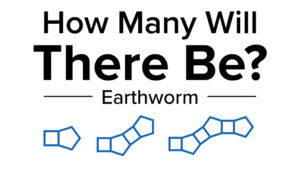
How Many Will There Be? Earthworm
Give kids a taste of a sequence, let them build an understanding, and then see how far their predictions can take them.

Comparing Fraction Strategies
For TeachersComparing fraction strategies? Let’s take it even further!

Aim High, Scaffold Down in Math
For TeachersA high level of thinking in math also requires the support of thoughtful scaffolding.

Categorize and Re-Categorize Animals
Put these animals into groups. Then do it again. Then… do it one more time. How does re-re-grouping the same creatures reveal new patterns and give new insights?

From “Identify” to “Analyze” – Famous Structures
For TeachersRather than just learning about one structure, let’s climb Bloom’s and think more deeply.

Thanksgiving Photo Writing
Starting with an old-timey photo, students will write from a particular item’s point of view.
Discussing An Important Decision from History
How would people with two different perspectives discuss a decision from history?

Famous Structures
The Eiffel Tower, the Colosseum, the Sydney Opera House — group them, pick the best from each group, then design your own.

Creativity Beyond The Fluff
For TeachersJust because a task is “creative” doesn’t mean students are at the top of Bloom’s Taxonomy.
Introducing Universal Theme of Conflict
So what could you do with a Universal Theme of Conflict? Well, here’s an introduction that will get your students’ brains sweating.

Back to School: Rewriting The Beatles’ “Help!”
Can your students come up with a one-syllable word to sum up their time away from school? And then rewrite The Beatles’ song Help!?

Introducing Universal Theme of Change
Everything changes. But how does it change? Students brainstorm dozens of examples and boil them down to one big idea.

Introducing Universal Theme of Power
So what could you do with a Universal Theme of Power? Well, here’s an introduction that will get your students’ brains sweating.

Notice, Wonder: SLS Test
A mysterious image. Reveal it slowly. Let your students wonder!

Writing About Art: Burning of the Houses of Lords and Commons
Look closely at Burning of the Houses of Lords and Commons. What do you notice? Now turn those details into a poem you didn’t know you could write.

Writing About Art: Impression, Sunrise
Look closely at Impression, Sunrise. What do you notice? Now turn those details into a poem you didn’t know you could write.

Earthquakes – Mixed Up Paragraph
Can you use the context clues to get these sentences about earthquakes back into the correct order?

Fizz Buzz: A Counting and Divisibility Game
Ready for a tricky counting and divisibility game?

Drawing Knots, Level 1
How to draw a simple version of this twisty Henri Matisse knot!

Notice, Wonder: Vortices
A mysterious image. Reveal it slowly. Let your students wonder!

Notice, Wonder: Swirls
A mysterious image. Reveal it slowly. Let your students wonder!

Notice, Wonder: Witch’s Fingers
A mysterious image. Reveal it slowly. Let your students wonder!

Rethinking Extension Menus
For TeachersIs creating nine, two-sentence tasks really an effective way to differentiate?

Greek and Latin Word Part Paths
How can we go from Biology to Immobile?

Precipitation Tournament
Eight types of precipitation battle it out in this tournament.

Writing About Art: Chōshi in Shimosha
Get your students writing some pretty darn impressive poetry based on Japan’s most famous artist.

Brain Needs or Heart Needs
For TeachersWe think of gifted kids as only having academic needs, but – in their own words – they also have many needs of the heart.

Explain Concepts with the Frayer Model
For TeachersGiving a definition just doesn’t cut it! Use the Frayer Model to explain (and assess!) vocabulary.

Not Like The Others: Branches of the US Government
How is each part of the United States Government not like the other parts?

Fancier Figurative Language: Move the Simile
What if we started a sentence with the simile?

Analyzing Conflict with the Content Imperatives
How to go deep into conflict using the Content Imperatives.

Ultimate (or Inception) Tic Tac Toe
What if each square on a Tic-Tac-Toe board had another Tic-Tac-Toe board inside of it?

Writing About Art: The Scream
Your students will turn the iconic painting The Scream into a vivid, sensory poem.
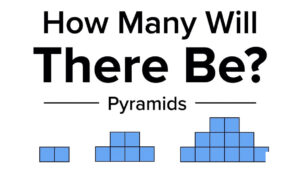
How Many Will There Be? Pyramids
Give kids a taste of a sequence, let them build an understanding, and then see how far their predictions can take them.

Concept Attainment: Art
Can your students tell the difference between cubism and abstract art?
Content Imperatives
For TeachersLearn to use the Content Imperatives, a set of five additional tools that work with Depth and Complexity.

Difficult vs Complex Tasks
For TeachersWhat separates difficulty from complexity? And why do complex tasks lead to much more natural differentiation?
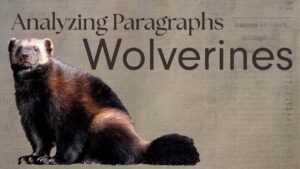
Analyze Paragraphs: Wolverines
Three paragraphs about wolverines. They all cover the same topic — so what makes each one different? Now combine them into one super-paragraph.

Who Asks The Questions? And Who Answers?
For TeachersWhat would the pie chart look like for these three situations: the teacher asks the students, a student asks the teacher, or a student asks another student a question? I can tell you my pie chart would have been very lopsided.

A Lunar Survival Mission
A favorite of mine! This task is delightfully complex and ambiguous, forcing students to make choices without enough information and with no right answer. How will they survive on the moon for three days?

Creating Sequences of Questions
For TeachersHigh-level questions on their own simply aren’t enough. We must create sequences of questions!

Inferring With Art: A Man
What’s going on in this painting? Who is that guy? What’s his job? And where’s his other boot?

Inferring With Art: A Couple
What’s going on in this room? There are shoes everywhere! Are those… oranges? Let’s make some inferences!

Self Portraits: Text Art
What if a students’ self-portrait was made of words that describe the student!?

An Escher-Style Tessellation Project
Create a piece of repeating art in the style of MC Escher!

Self Portraits Part One: Line Drawings
Anyone, yes anyone, can create a (somewhat) realistic self-portrait using these steps. Anyone!

Self Portraits: Pointillism
Turn your students into a bunch of Monets with q-tips and some tempera paint.

Not Like The Others: Natural Disasters
Four natural disasters. One doesn’t belong. But which one? That depends on your argument.

Game: Snakes
In this grid-based strategy game, who will be the last to add to the snake?

Math Game: Heaps
Try this a simple (but surprisingly strategic) subtraction game!

Notice, Wonder: A Long Line
A mysterious image. Reveal it slowly. Let your students wonder!

Ambiguous Sentences
Rather than just demand that students “write clearly,” we’ll explore the hazards of poorly written sentences… and maybe create one of our own!

Generalization: Change Leads to More Change
Can you think of a time in your life when “Change lead to more change?”
Generalization: Systems Are Made up of Other Systems
A clock is a system. So is a rainforest. So is your school. Once you see systems inside systems, you can’t unsee it.
Invisible Power Can Have Visible Effects
Can you think of times when power is unseen, but we can clearly see its effects?

Virtue or Vice?
Aristotle noted that positive traits and negative traits are often the same thing, but just in different amounts. The right amount is a virtue, but too much or too little and it’s a vice.

SCAMPER: Scaffolding Creativity
Asking students to “think creatively” won’t get you far. They won’t know how to start, they’ll get stuck with simple ideas, or they’ll just go completely wild. SCAMPER is a tool for scaffolding the process of creativity.

Disneyland Parking Structure Math Project
Your students will use estimation strategies to figure out how many parking spots are there in the parking structure at Disneyland? And you bet I reveal the real answer!

Parentheses: How big of a change can they make!?
Two tiny parentheses. One expression. How big of a change can they make? Bigger than you think.

Asking Questions That Make Students Think
For TeachersMost classroom questions test memory. These questions test thinking. There’s a difference — and your students will feel it.

Improving Wait Time
For TeachersHow much time do your students get to think after a question? Probably not enough. Here’s how to fix that.

Paragraphs: Systems of Sentences
Blow up a paragraph into individual sentences. Now reassemble it. The clues hiding in each sentence will surprise you.

What’s In My Brain: Trapezoids or Not?
Which are trapezoids and which are not?

Not Like The Others: Creatures of the Tundra
Four tundra creatures. One doesn’t belong. But which one? That depends on your argument.

The Tournament of Biomes
Want to move beyond memorizing the characteristics of biomes? In this lesson, students work through a Tournament of Biomes, explaining which biome wins in each round (based on criteria you choose). In the end, they crown a 👑 Champion Biome!

Notice, Wonder: Turbine
Your students will be surprised by the size of this turbine… and by what’s hanging from it!

Advanced Alliteration and Consonance
When students learn about alliteration, it’s hard to steer them away from goofy tongue-twisters. Certainly, there must be more powerful and practical ways of using alliteration. In this lesson, I draw on delicious examples from Shakespeare to show how a very advanced writer used alliteration. Then, I break those ideas down so students can try them out.

Fraction Ordering Tournament
Which set of fractions would be the trickiest to order from least to greatest? Let’s have a tournament!

The Personalities of Rocks
What would an igneous rock be like? Would it get along with a sedimentary rock? Could they handle the hot personality of a metamorphic rock?

Undoing Multiplication With Division
Multiplication and division, natural foes, are constantly seeking to undo each other. Students will attempt to reverse the effects of multiplication by dividing once, twice, or even thrice!

Exponents – How Low Can They Go?
Using exponent patterns, can students predict what the 0th power will be?

Math Curiosity: The Coloring Problem
No video gets me more email from students! How few colors can you use to color in any map so that no two, neighboring regions are the same color?

Place Value (Beyond Base 10)
Place value is something we cover in elementary school. It seems simple, but I’d wager that very few adults really understand the topic. I sure didn’t until I worked with non-base-10 number systems in college. Your students can get a taste of this mind-boggling experience by imagining what it would be like if we didn’t have the number 9. What would each digit represent then?

The Resiliency Tournament
Your students will set up a tournament to determine which person or character best demonstrated resiliency.

The Angles of a Triangle
Why tell a kid the rules of a triangle when they can discover them!?

Deducing the Area of Triangles
Using patterns, students try to deduce where that area formula came from.
Upgrading Compare and Contrast Writing
Upgrade compare and contrast writing with just a couple of key words.

Describing Author’s Voice
What if… Edgar Allen Poe wrote Alice’s Adventures in Wonderland?

What Does it Cost to Fill a Car with Other Liquids
Is gas actually that expensive? What if we filled a car up with… orange juice?

Math Curiosity: Odds & Squares
Why does the sum of the first 5 odds also equal 5 squared?

Investigating Cost of Living
Would you save money if you lived in Las Vegas and commuted every day to San Francisco?

Doubling Dollars
Say you have a dollar. Say you can double that dollar each day: $1, $2, $4, and so on. How long will it take to reach… one million dollars? Not as long as you might think!

Fractals: Koch Snowflake
You could keep zooming in on this snowflake forever!

A Donut Investigation
In this cross-curricular investigation, students will look into an intriguing question: do donuts or salads have more sugar? They’ll grapple with misleading information, bias, and use their math skills to create a visual representation of sugar in popular foods.

Jabberwocky and Context Clues
Context clues lessons can be a disaster. Here, we expose students to a delightful classic packed with nonsense words (“Jabberwocky”) and ask them to decipher the meanings and parts of speech. Then, it’s only natural for students to write their own nonsense poems.

Showing A Character’s Trait
We tell students to ‘show, not tell’ — but that advice is useless until they experience the difference. This lesson makes it click.

Create A Civilization: Calendars
Why 12 months? Why 30ish days? Why 7 days in a week? Your civilization could organize a year in any way you want!

Multiple Meaning Matcher – Introduction
Your students will try to match up definitions that belong to the same homophone in this brain-boggling vocab puzzle.

Universal Themes
For TeachersUniversal Themes are an easy way to connect lessons, units, and content areas, even going across grade levels, and into students’ personal interests.

Math Curiosity: Primes and Squares
Can any perfect square be written as the sum of two primes?

Math Curiosity: Legendre’s Conjecture
It seems like there’s always a prime number between two perfect squares… but is this always the case!?

Math Curiosity: Finding Primes
Prime numbers are unpredictable! How can we possibly find them all? An Ancient Greek mathematician found one way!

Content Imperatives: Paradox
How can one idea pull in opposite directions, being both true and false or right and wrong at the same time? It’s time to explore Paradoxes!

Studying and Remixing “The Raven”
Ready to push kids beyond the boring, old ABAB rhyme scheme and into something a bit more complex?

Persuasion and Packaging: Ethos, Pathos, and Logos
How does a drink’s packaging affect us emotionally and logically?

Depth and Complexity: 🏛️ Big Idea
Let’s get students thinking big and focusing on more abstract ideas.

Depth and Complexity: 👓 Multiple Perspectives
Every topic looks different depending on who’s looking. This prompt teaches students to see through someone else’s eyes.

Depth and Complexity: 🌻 Details
Get kids focusing on the small, but essential, details of a topic.

Analyze Character Change with Depth and Complexity
Your students will use Depth and Complexity to note how a character’s main trait changes across a story.

Create A Civilization Introduction
Your students build a civilization from scratch — rivers, flags, calendars, currency, government. Social studies, science, and writing woven into one year-long project.

Inductively Analyze Website Reliability
For TeachersRather than giving students rules to apply to websites, let them analyze websites to create rules.

Exploring Circumference With Famous Circles
Let’s find how the diameter and circumference of famous circles are related.

Historic Social Media
How would people from history have interacted online? Students will develop a conversation online between people involved in the same event from history.

Running A Curiosity Based Research Project
Skip the assigned topics. Let students research what they’re genuinely curious about — here’s how to structure it so it actually works.

Analyze and Create Misleading Graphs
Let’s make some intentionally bad graphs to learn how to spot poorly made graphs.

Create A Creature
Create a new creature based on the adaptations of existing creatures from the same biome.

The Game of 100
Who can get to 100 first in this simple, but delightful, math game?

Writing Summaries in Haiku
Let’s write a summary. A very short summary. With VERY strict rules.

Furnishing A Hotel
Design and furnish hotel rooms on a budget. Real math, real constraints, real decisions. Then pitch your hotel to investors.

A Grid-Based Fraction Project
You’ve got 60 spaces on a grid to create an amusement park, a house, a farm, or whatever you’d like. Divide it into seven pieces, order it by size, combine into two halves, and more in this fraction project.

Common English Words From Other Languages
Bored with typical spelling studies? Let’s dig into the origins of common English words from other languages!

An Inductive Exploration Of Geometry
For TeachersWith inductive thinking, students will work from parts to whole, discovering big ideas along the way!

Math Project: What If I Bought Apple Stock Instead?
What if you had an original iPod and sold it compared to if you had bought the equivalent amount of Apple stock and sold that?

Greek and Latin Dinosaur Names
Let’s create a new dinosaur using Greek and Latin stems!

Can Students Solve Your Classroom Layout Problems?
For TeachersWhat if your students designed your classroom layout?

Ethics In The Young Elementary Classroom
For TeachersCan kindergartners discuss ethical issues? Yes. Here’s how to weave multiple-perspective problems throughout your curriculum.

Engineering: Build A Bridge
Using real bridges as their starting point, students will construct bridges out of straws and paperclips.

Add Layers To Direct Instruction
For TeachersTake direction instruction beyond a monotonous practice of the same skill over and over.

Better Stories Part 2: Types of Conflict
If your students’ stories are packed with endless ninja fights or arguments between frenemies, it’s time to expose them to a wider range of conflicts.

Better Stories Part 1: The Big Idea
We open our unit on narrative writing with a big idea: “structure increases creativity.” I show how this is true by bringing in examples from across all disciplines.

Better Stories Part 4: Character Archetypes
Are students’ characters a bit flat? Archetypes give them a strong foundation on which to build their own characters as well as a tool to analyze existing stories.