


Playlist: ELA

Antagonyms: Dust, Clip, and Left
Dust can mean “remove dust” but also “add more dust!”

Characters’ Faults Can Also Be Strengths
Strength and weakness are often two sides of the same coin. Students will explore how a character’s flaw can be a benefit.

Words Within Words: February
How many words can you find within February?

Words Within Words: Chocolate
How many words can you find within Chocolate?
Halloween Problems and Solutions
When we try to solve a problem, sometimes we end up creating new problems. Which lead to new solutions. Which lead to new problems.

Word Ladder: Fly to Bee (6-steps)
COLD to COOL. BAND to SING. Change one letter at a time — can you find the path?

St. Patrick and Other Legends
How would real people feel about the legends that have been created about them?

Words Within Words: PATRICK
How many words can you find within Patrick?

Words Within Words: RAINBOW
How many words can you find within rainbow?

Words Within Words: IRELAND
How many words can you find within Ireland?

Getting Specific With St. Patrick’s Day Writing
Let’s take a starting phrase about St. Patrick’s Day and get specific. No, even more specific!

Comparing Characters’ Bedrooms
What item’s in a character’s bedroom would reflect their deepest desires? And what if they toured a similar character’s room?

Change A Story’s Genre
What if we rewrote a story’s climax into a totally different genre?

Words Within Words: LATKES
How many words can you find within LATKES?

Order, Chaos, and the Holiday Season
Let’s write a holiday song about order and chaos!

Holiday Emoji Story ⛷️
Five emoji. One story. Where will your imagination take you?

Holiday Emoji Story 🚚
Five emoji. One story. Where will your imagination take you?

Words Within Words: CORNMAZE
How many words can you find within CORNMAZE?

Words Within Words: COBWEB
How many words can you find within COBWEB?

Halloween Emoji Story 🎃
Five emoji. One story. Where will your imagination take you?

Emoji Stories 🏟️
Five emoji. One story. Where will your imagination take you?

Emoji Stories 🕰️
Five emoji. One story. Where will your imagination take you?

Emoji Stories 🤖
Five emoji. One story. Where will your imagination take you?

Emoji Stories 🏰
Five emoji. One story. Where will your imagination take you?

Emoji Stories 🛥️
Five emoji. One story. Where will your imagination take you?

Plexidemokinesis (Greek and Latin)
What on earth is a Plexidemokinesis? Break apart the Greek and Latin roots, figure out what it should mean, then invent what it describes.

Hydromagnaphone (Greek and Latin)
What on earth is a Hydromagnaphone? Break apart the Greek and Latin roots, figure out what it should mean, then invent what it describes.

Aquamorphotron (Greek and Latin)
What on earth is a Aquamorphotron? Break apart the Greek and Latin roots, figure out what it should mean, then invent what it describes.

Chronosonarium (Greek and Latin)
What on earth is a Chronosonarium? Break apart the Greek and Latin roots, figure out what it should mean, then invent what it describes.

Pluto – Mixed Up Paragraph
Can you use the context clues to get these sentences about Pluto back into the correct order?

Great Sloths – Mixed Up Paragraph
Can you use the context clues to get these sentences about great sloths back into the correct order?

The Moon – Mixed Up Paragraph
Can you use the context clues to get these sentences about The Moon back into the correct order?

The Great Sphinx – Mixed Up Paragraph
Can you use the context clues to get these sentences about The Great Sphinx back into the correct order?

Rainclouds – Mixed Up Paragraph
Can you use the context clues to get these sentences about rain clouds back into the correct order?

Coral Reef – Mixed Up Paragraph
Can you use the context clues to get these sentences about the coral reef back into the correct order?

Mother’s Day Cards
Let’s write the cleverest Mother’s Day cards you’ve ever seen!

Multiple Meaning Matcher – Theta
Can your students match multiple meanings of the same five words?

Multiple Meaning Matcher – Eta
Can your students match multiple meanings of the same five words?

Multiple Meaning Matcher – Epsilon
Can your students match multiple meanings of the same five words?

Multiple Meaning Matcher – Delta
Can your students match multiple meanings of the same five words?

Multiple Meaning Matcher – Beta
Can your students match multiple meanings of the same five words?

Multiple Meaning Matcher – Alpha
Can your students match multiple meanings of the same five words?
Parts of Speech Party – Gift
How many different ways can we use the word “gift” in a single paragraph? Let’s find out in this Parts of Speech Party!

Parts of Speech Party – Care
How many different ways can we use the word “care”? Let’s find out in this Parts of Speech Party!
Parts of Speech Party – Fruit
How many different ways can we use the word “fruit”? Let’s find out in this Parts of Speech Party!
Parts of Speech Party – Change
How many different ways can we use the word “change”? Let’s find out in this Parts of Speech Party!

Words Within Words: ORNAMENT
How many words can you find within ORNAMENT?

Words Within Words: WREATH
How many words can you find within WREATH?

Bobbing for Apples
What is bobbing for apples like… for an apple?

Words Within Words: SCARECROW
How many words can you find within “scarecrow”?

Words Within Words: CRANBERRY
How many words can you find within “cranberry”?

Words Within Words: STUFFING
How many words are hiding inside STUFFING? More than you think.

A Halloween Costume Gone Wrong
Let’s go roller skating in a Halloween costume! What could possibly go wrong?

Super Specific Similes – Slimy Broccoli
Start with a basic simile. Now make it more specific. Now even more. Watch how much better writing gets with each round.
Super Specific Similes: Quick Baby
Let’s make this simile about a quick baby even more specific.

Super Specific Similes: Loud Class
Let’s make this simile about a loud class super specific!

Robot Writing: Volcano
Read three pieces of writing from three different robots about the same beautiful painting of a volcano. Who wrote it best?

Robot Writing: Acropolis
One painting of ruins. Three robots. Three pieces of writing. Who wrote it best?

Robot Writing: The Bridge
One painting of a bridge. Three robots. Who wrote it best?

Robot Writing: Orchestra
Read three pieces of writing from three different robots based on a beautiful painting and decide who wins!

Words Within Words: GENERAL
How many words can you find within “general”?

Words Within Words: Intro (SOLDIER)
How many words can you find within SOLDIER? 20? 35? 50? Even more!?

Words Within Words: WESTERN
How many words can you find within WESTERN?

Words Within Words: TEACHER
How many words can you find within TEACHER?

Idioms About Money
Five sets of idioms related to money.

Idioms About Fire
Five sets of idioms related to fire!

Word Pyramid: U to Brush
Add a letter at each step to form a new word. Can you connect the starting point and ending point?

Words Within Words: PARKING
How many words can you find within PARKING?

Prefixes and Suffixes in Other Languages
Let’s go beyond merely memorizing word parts and instead analyze across languages. How do other languages make a word the opposite?

Idioms about Weather
Five sets of idioms related to the weather.

Words Within Words: TROMBONE
How many words can you find within TROMBONE?

Idioms About Red
Five sets of idioms related to the color red.

Analyze Suffixes: -en
What exactly does adding -en to a word do? Find the pattern. Then find the words that break it.

Lipogram: Rewrite “Mary Had A Little Lamb”
What if we rewrote a piece of writing without using certain letters?

Lipogram: Rewrite “Twinkle, Twinkle”
What if we rewrote a piece of writing without using certain letters?

Looking Closely at Holiday Photos
Let’s write from multiple perspectives using an old timey holiday photo!

Holiday Writing: Packing Crates
An old photograph. A holiday scene. Pick one object in the picture and write from its point of view.

Thanksgiving Photo Writing
Starting with an old-timey photo, students will write from a particular item’s point of view.

Writing About Art: Impression, Sunrise
Look closely at Impression, Sunrise. What do you notice? Now turn those details into a poem you didn’t know you could write.

Automobiles – Mixed Up Paragraph
Can you use the context clues to get these sentences about automobiles back into the correct order?

Washington, DC – Mixed Up Paragraph
These sentences about Washington, DC got scrambled. Can you put them back in order using nothing but context clues?

Trains – Mixed Up Paragraph
Can you use the context clues to get these sentences about trains back into the correct order?

Earthquakes – Mixed Up Paragraph
Can you use the context clues to get these sentences about earthquakes back into the correct order?

Words Within Words: AIRPLANE
How many words can you find within airplane?

Words Within Words: LEOPARD
How many words can you find within “leopard”?

Words Within Words: SATURN
How many words can you find within Saturn?

Sets of Idioms Related to Numbers
Two sets of idioms related to numbers.

Five Sets of Bird and Bug Idioms
Five sets of idioms related to birds (and bugs).

Word Pyramid: P to PLAINS
Add a letter at each step to form a new word. Can you connect the starting point and ending point?

Word Pyramid: T to PLANET
Add a letter at each step to form a new word. Can you connect T and PLANET?

Word Pyramid: I to LIONS
Add a letter at each step to form a new word. Can you connect the starting point and ending point?

Sets of Idioms Related to Food
Five sets of five idioms, all related to food.

Word Pyramid: T to Patch
Add a letter at each step to form a new word. Can you connect the starting point and ending point?

Greek and Latin Word Part Paths
How can we go from Biology to Immobile?

Parts of Speech Tournament
Which part of speech is most useful? Interesting? Strange?

Writing in Pilish
Pi can go beyond circles! What if you wrote using the digits of pi as your guide?

Writing About Art: Chōshi in Shimosha
Get your students writing some pretty darn impressive poetry based on Japan’s most famous artist.

Writing About Art: Wanderer Above the Sea of Fog
Look closely at Wanderer Above the Sea of Fog. What do you notice? Now turn those details into a poem you didn’t know you could write.

Writing About Art: Twilight in the Wilderness
Look closely at Twilight in the Wilderness. What do you notice? Now turn those details into a poem you didn’t know you could write.

Antonym Paths
Does the antonym of an antonym bring us back to the same meaning?

Fancier Figurative Language: Use the Opposite
Let’s start with “As cold as fire.”

Fancier Figurative Language: Move the Simile
What if we started a sentence with the simile?
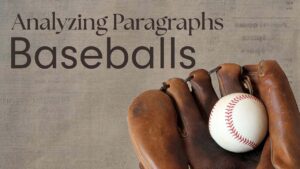
Analyze Paragraphs: Baseball
Three paragraphs about baseball. They all cover the same topic — so what makes each one different? Now combine them into one super-paragraph.
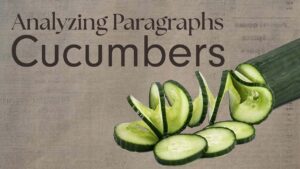
Analyze Paragraphs: Cucumbers
Three paragraphs about cucumbers. They all cover the same topic — so what makes each one different? Now combine them into one super-paragraph.

Analyze Paragraphs: Empire State Building
Three paragraphs about the Empire State Building. They all cover the same topic — so what makes each one different? Now combine them into one super-paragraph.
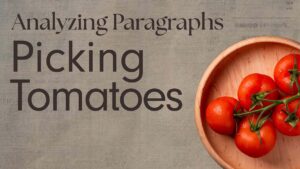
Analyze Paragraphs: Tomatoes
Three paragraphs about tomatoes. They all cover the same topic — so what makes each one different? Now combine them into one super-paragraph.
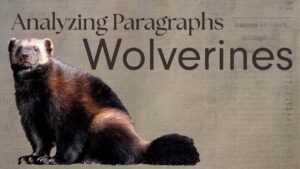
Analyze Paragraphs: Wolverines
Three paragraphs about wolverines. They all cover the same topic — so what makes each one different? Now combine them into one super-paragraph.

Word Ladder: East to West (4 Steps)
COLD to COOL. BAND to SING. Change one letter at a time — can you find the path?

Word Ladder: Work to Hard (4 Steps)
COLD to COOL. BAND to SING. Change one letter at a time — can you find the path?

Word Ladder: Two to Six (6-steps)
COLD to COOL. BAND to SING. Change one letter at a time — can you find the path?

Word Ladder: Fast to Race (4 step)
COLD to COOL. BAND to SING. Change one letter at a time — can you find the path?

Word Ladder: Arm to Leg (6-steps)
COLD to COOL. BAND to SING. Change one letter at a time — can you find the path?

Word Ladder: Kid to Old (5-steps)
COLD to COOL. BAND to SING. Change one letter at a time — can you find the path?

Word Ladder: Sky to Red (5-steps)
COLD to COOL. BAND to SING. Change one letter at a time — can you find the path?

Word Ladder – Sun to Hot (5-steps)
COLD to COOL. BAND to SING. Change one letter at a time — can you find the path?

Word Ladder – Tea to Hot (5-steps)
COLD to COOL. BAND to SING. Change one letter at a time — can you find the path?

Word Ladder: Band to Sing (4 Steps)
COLD to COOL. BAND to SING. Change one letter at a time — can you find the path?

Word Ladder: Foot to Shoe (4 Steps)
COLD to COOL. BAND to SING. Change one letter at a time — can you find the path?
Changing Coordinating Conjunctions
What happens when we switch out a “but” with a “so”? An “and” with a “for”? How can such tiny words make such big differences?

Fixing Shakespearean Run-Ons
Can your students help The Bard? We’ll fix five Shakespearean run-ons in three different ways.
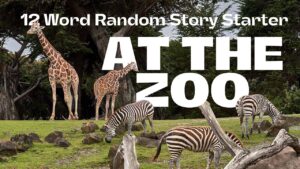
12 Phrases: The Zoo
Students use 12 random phrases to create a story that takes place at the zoo.

Story Starter: A Day At School
Students use 12 random phrases to create a story that takes place at school.

Story Starter: Out To Eat
Students pick from 12 random phrases to create a story about an incident in a restaurant.

Story Starter: Amusement Park
Students use 12 random phrases to write a story that takes place in at an amusement park.

Story Starter: A Magical School
Students use 12 random phrases to create a story that takes place in at a magical school.

Story Starter: Somewhere In Space
Students use 12 random phrases to create a story that takes place in space!

Writing Sample: Alice’s Adventures in Wonderland (Shrinking)
A passage from Alice’s Adventures in Wonderland to use as a mentor text, discussion starter, or writing prompt.

Writing Sample: The Velveteen Rabbit (The Toys)
A passage from The Velveteen Rabbit to use as a mentor text, discussion starter, or writing prompt.
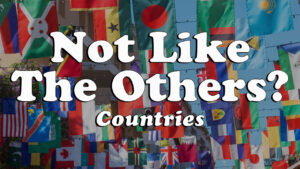
Not Like The Others: Countries
How is each of these four countries not like the others?
Writing A Thanksgiving Letter
What if an inanimate object could express thanks for a special person in your life? What would it write?

Ambiguous Sentences
Rather than just demand that students “write clearly,” we’ll explore the hazards of poorly written sentences… and maybe create one of our own!

Words Within Words: MENORAH
How many words can you find within MENORAH?

Remixing A Holiday Poem
Let’s take a classic Christmas poem and remix it to work with another holiday!

Characters Dressed as Other Characters for Halloween
What if one character dressed up as another for Halloween? Would the Cat in the Hat pick Captain Jack Sparrow, because they’re both chaotic yet good-natured people? Would Elsa dress up as The Ice King since they are both lonely?

Virtue or Vice?
Aristotle noted that positive traits and negative traits are often the same thing, but just in different amounts. The right amount is a virtue, but too much or too little and it’s a vice.

Punctuation Power
In a sentence, punctuation may seem meek when compared to those mighty words, but punctuation has incredible power over the meaning of a sentence. Students will try re-punctuating sentences to find new meanings – without changing a single word!

Writing Seuss Style Poetry
Sure, Dr. Seuss wrote for young students, but can older students analyze his writing and learn to mimic his style? THEN, they can produce Seuss-style poetry about any topic: Ancient China, the electromagnetic spectrum, Pride and Prejudice, and (yes) fraction division!

What’s In My Brain: May vs May
The word “may” can be used for possibility or permission. It’s a modal auxiliary verb!

Plurals: An Inductive Spelling Lesson
Plural nouns in English are deliciously fascinating. Yet most plural lessons are so dull! In this experience, students are given a pile of plurals and then inductively create groups and pull out rules and patterns.

Paragraphs: Systems of Sentences
Blow up a paragraph into individual sentences. Now reassemble it. The clues hiding in each sentence will surprise you.

Not Like The Others: Charlotte’s Web
Four Charlotte’s Web characters. One doesn’t belong. But which one? That depends on your argument.

Fancier Figurative Language: Advanced Repetition
Is your students’ use of repetition limited to, “The girl was very, very, very fast.”? Let’s borrow some ideas from Shakespeare!

Advanced Alliteration and Consonance
When students learn about alliteration, it’s hard to steer them away from goofy tongue-twisters. Certainly, there must be more powerful and practical ways of using alliteration. In this lesson, I draw on delicious examples from Shakespeare to show how a very advanced writer used alliteration. Then, I break those ideas down so students can try them out.

Writing Sample: The Wind in the Willows
A passage from The Wind in the Willows to use as a mentor text, discussion starter, or writing prompt.

Writing Sample: Peter Pan
A passage from “Peter Pan” to use as a mentor text, discussion starter, or writing prompt.

Writing Sample: Dr. Jekyll and Mr. Hyde
A passage from “Dr. Jekyll and Mr. Hyde” to use as a mentor text, discussion starter, or writing prompt.

What’s In My Brain: Painting vs Painting
Two columns of sentences. Something is different about them. Can you figure out the rule?

What’s In My Brain: Cute Baby vs Fast Cheetah
Can students spot similes vs metaphors?

What’s In My Brain – Independent vs Dependent
These clauses are sorted into two groups. What’s the rule? No definitions given — just examples.

Simple or Compound Sentences – What’s In My Brain?
Can your students spot simple sentences vs compound sentences?

Run On or Not? – What’s In My Brain
Can your students spot the run-on sentences?

Complex or Compound – What’s In My Brain
Can your class spot the complex sentences vs compound sentences?

What’s In My Brain: Progressive vs Simple Tenses
Will your students notice progressive tense vs simple tense?

What’s In My Brain – The Park vs The Museum
We’re looking at the past progressive tense and the simple past tense.
Parts of Speech Party – Well
How many different ways can we use the word “well”? Let’s find out in this Parts of Speech Party!
Parts of Speech Party – Thanks
How many different ways can we use the word “thanks”? Let’s find out in this Parts of Speech Party!
Parts of Speech Party – Limit
How many different ways can we use the word “limit”? Let’s find out in this Parts of Speech Party!

Pronouns With Too Many Antecedents
What happens when a pronoun could refer to more than one noun? Big problems!

Words Within Words: NUTCRACKER
How many words can you find within NUTCRACKER?
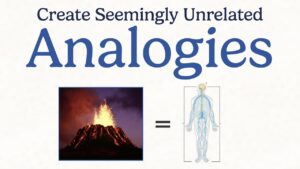
Building Creative Analogies
We’ll take two seemingly unrelated pieces of content (say volcanoes and the human body) and then build analogies to connect the two ideas. In the end, students can create a skit, comic, or story relating the two concepts.

Synonym Graphs
So, which is happiest: happy, joyful, or ecstatic? Which is most temporary?

Passive to Active Voice
In this lesson, students will not just fix passive sentences, but break active sentences as they learn to put the star of the sentence first.

Jabberwocky and Context Clues
Context clues lessons can be a disaster. Here, we expose students to a delightful classic packed with nonsense words (“Jabberwocky”) and ask them to decipher the meanings and parts of speech. Then, it’s only natural for students to write their own nonsense poems.

Showing A Character’s Trait
We tell students to ‘show, not tell’ — but that advice is useless until they experience the difference. This lesson makes it click.

Improving Presentations 3: The Storyboard and Slides
It’s time to turn that outline into a storyboard and then some actual slides.

Improving Presentations 2: Planning The Outline
After watching some great presenters, let’s outline your presentation!

Improving Presentations 1: Watching The Greats
Get better at giving presentations by studying the greats!

Persuasion and Packaging: Ethos, Pathos, and Logos
How does a drink’s packaging affect us emotionally and logically?

Analyze Character Change with Depth and Complexity
Your students will use Depth and Complexity to note how a character’s main trait changes across a story.

“Its Big Day” – A Children’s Story About Its and It’s
Let’s spice up a typically dull lesson about the difference between “its” and “it’s” by asking students to write a children’s story about the adventures of a critter named It.

Literary Technique: Juxtaposition
Put a grumpy character next to a joyful one and they make each other stand out even more. Opposites are powerful!

Ways to Start a Sentence – Level 1
‘Add more variety!’ teachers say. But how? This lesson gives students actual techniques instead of vague advice.

Motivation and Moral Development
Can someone do the right thing, but for the wrong reason?

Writing Summaries in Haiku
Let’s write a summary. A very short summary. With VERY strict rules.

Common English Words From Other Languages
Bored with typical spelling studies? Let’s dig into the origins of common English words from other languages!

Fancier Figurative Language: Start with a Cliche
We’ll start with the cliché “as cold as ice” and go somewhere much more interesting.

Writing Clear Directions
Can you write directions so clear that a group of kids can put a toy together with no illustrations?

Greek and Latin Dinosaur Names
Let’s create a new dinosaur using Greek and Latin stems!