


Playlist: Bookmarks

Letters With Symmetry
Let’s group letters by their symmetry, then create symmetrical words, and then symmetrical sentences!

Crossing Every Bridge Exactly Once (aka Eulerian Paths)
How can you cross each bridge in this city exactly once?

Words Within Words: Intro (SOLDIER)
How many words can you find within SOLDIER? 20? 35? 50? Even more!?

Categorize and Re-Categorize Animals
Put these animals into groups. Then do it again. Then… do it one more time. How does re-re-grouping the same creatures reveal new patterns and give new insights?

Drawing Knots, Level 2
How to draw a more complex version of this twisty Henri Matisse knot!

Drawing Knots, Level 1
How to draw a simple version of this twisty Henri Matisse knot!

Parabolic Curve Art
Create mathematical art with curves that, well, aren’t curvy.

Analyzing Conflict with the Content Imperatives
How to go deep into conflict using the Content Imperatives.

Looping Grid Art
Pick a few numbers, draw some corresponding lines on grid paper, and you’ll end up with some interesting, looping math-y art!

Analyze Characters Using Philosophy
What is the Brick Pig’s philosophy? How would he apply it to the characters in Harry Potter?
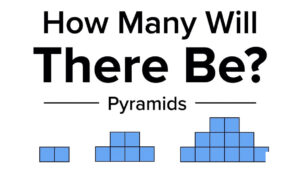
How Many Will There Be? Pyramids
Give kids a taste of a sequence, let them build an understanding, and then see how far their predictions can take them.
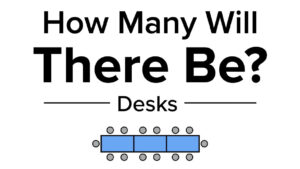
How Many Will There Be? Desks
Give kids a taste of a sequence, let them build an understanding, and then see how far their predictions can take them.

A Lunar Survival Mission
A favorite of mine! This task is delightfully complex and ambiguous, forcing students to make choices without enough information and with no right answer. How will they survive on the moon for three days?

Word Ladder: Fast to Race (4 step)
COLD to COOL. BAND to SING. Change one letter at a time — can you find the path?

Inferring With Art: A Man
What’s going on in this painting? Who is that guy? What’s his job? And where’s his other boot?

Game: Number Scrabble
What if we played Tic-Tac-Toe with numbers and instead of three-in-a-row, we add up to 15? Well… then we’d have Number Scrabble!

Self Portraits: Text Art
What if a students’ self-portrait was made of words that describe the student!?

An Escher-Style Tessellation Project
Create a piece of repeating art in the style of MC Escher!

Measurement: An Elephant
What if I told you that an elephant weighed a back-breaking 176,000? Could you figure out the unit I’m using? But… how many corgis would that be?

Measurement: How Big is this Bathtub?
So, if I told you a bathtub holds 640 of water, which unit would make the most sense?

Measurement: How Old Is Mr. Byrd?
What if I told you that I’m 341,640 old? Could you figure out what unit I’m using? Hint: it’s not years!
Changing Coordinating Conjunctions
What happens when we switch out a “but” with a “so”? An “and” with a “for”? How can such tiny words make such big differences?

Game: Snakes
In this grid-based strategy game, who will be the last to add to the snake?

Jotto
Who can guess the codeword first?

Writing Technique: 3 Dependent Clauses
A specific technique to help students add some spice to their writing. We’ll be writing sentences with three dependent clauses.

Math Curiosity: Klauber’s Triangle
In 1932, a leading authority on rattlesnakes, Laurence Klauber, discovered a startling pattern within a triangle of primes.
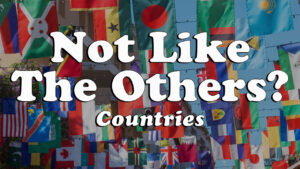
Not Like The Others: Countries
How is each of these four countries not like the others?

Math Curiosity: A Pattern Packed Triangle
Pascal’s pattern-packed triangle is a potent puzzle for pupils to ponder.

Holiday vs Holiday (from a Mascot’s Perspective)
Want something to do during the holiday season that is both fun and involves thinking? Get students writing about what a snowman would think about Halloween or what a ghost would think about Thanksgiving.

Characters Dressed as Other Characters for Halloween
What if one character dressed up as another for Halloween? Would the Cat in the Hat pick Captain Jack Sparrow, because they’re both chaotic yet good-natured people? Would Elsa dress up as The Ice King since they are both lonely?

Evens and Odds – Addition and Subtraction
When we’re adding and subtracting, do evens make odds into evens? Do odds make evens odd? Which one has… more power!?

Virtue or Vice?
Aristotle noted that positive traits and negative traits are often the same thing, but just in different amounts. The right amount is a virtue, but too much or too little and it’s a vice.

Create Your Own Operation
The commutative and associative properties are a whole lot more interesting when you apply them to a mathematical operation that you created!

Writing Seuss Style Poetry
Sure, Dr. Seuss wrote for young students, but can older students analyze his writing and learn to mimic his style? THEN, they can produce Seuss-style poetry about any topic: Ancient China, the electromagnetic spectrum, Pride and Prejudice, and (yes) fraction division!

Paragraphs: Systems of Sentences
Blow up a paragraph into individual sentences. Now reassemble it. The clues hiding in each sentence will surprise you.

Not Like The Others: US Presidents
Four US presidents. One doesn’t belong. But which one? That depends on your argument.
How Many Ways: Fraction Equivalence
How many different ways can you make this math statement true using only the digits one through nine?

The Tournament of Biomes
Want to move beyond memorizing the characteristics of biomes? In this lesson, students work through a Tournament of Biomes, explaining which biome wins in each round (based on criteria you choose). In the end, they crown a 👑 Champion Biome!

What’s In My Brain: Cute Baby vs Fast Cheetah
Can students spot similes vs metaphors?

Game: Order and Chaos
Imagine Tic-Tac-Toe if both players could play as both Xs and Os!

Writing A Story About Fraction Equivalence
When fractions take on a new denominator, it’s as if they’re wearing a disguise – same value, new look. So let’s write a story about fraction equivalence starring a fraction who needs to fit in with a new group.

Bulls and Cows
How quickly can you break the numeric code?

Same Perimeter, Different Area For Rectangles
Can two rectangles have the same perimeter but… different areas!?

Intersecting Angles and Streets
There can never be just one angle.

Exponents – How Low Can They Go?
Using exponent patterns, can students predict what the 0th power will be?

Student Introductions with Complexity and Frames
How have you changed over time? Students introduce themselves through the lens of change — and learn a Depth and Complexity tool in the process.

Student Introductions With Depth and Frames
Want to introduce the tools of Depth and Complexity and learn more about your students and introduce the Frame graphic organizer? Have I got the activity for you!

Math Curiosity: The Coloring Problem
No video gets me more email from students! How few colors can you use to color in any map so that no two, neighboring regions are the same color?

Game: Notakto
What if you only played Tic-Tac-Toe with Xs and you could play on multiple boards?

Dots and Boxes
Who can make the most boxes from dots in this strategy game?

Sprouts
Learn how to play the abstract, paper-and-pencil game Sprouts.

Why Is Our Calendar So Weird!?
Why are there 12 months? Why don’t weeks fit into months evenly? Why don’t weeks fit into the year evenly? What’s going on with the calendar!

The Resiliency Tournament
Your students will set up a tournament to determine which person or character best demonstrated resiliency.

The Angles of a Triangle
Why tell a kid the rules of a triangle when they can discover them!?

Grouping Quadrilaterals In A Hierarchy
Can we classify quadrilaterals like we classify living things?

Lines, Line Segments, Rays, and Infinity!
A lesson about lines, line segments, and rays that avoids dull memorization. Instead, we ponder this delightful question: Which is longer, a ray or a line? Then, kids consider what these different geometric concepts would think about each other.

Deducing the Area of Triangles
Using patterns, students try to deduce where that area formula came from.

Analyzing Movies’ Success
So should we make another movie in this series?
Building Creative Analogies
We’ll take two seemingly unrelated pieces of content (say volcanoes and the human body) and then build analogies to connect the two ideas. In the end, students can create a skit, comic, or story relating the two concepts.

Finding The Volume of Laptops
How has the volume of laptops changed over time? You know you want to check out how huge those first versions were!

What Does it Cost to Fill a Car with Other Liquids
Is gas actually that expensive? What if we filled a car up with… orange juice?

Synonym Graphs
So, which is happiest: happy, joyful, or ecstatic? Which is most temporary?

Investigating Cost of Living
Would you save money if you lived in Las Vegas and commuted every day to San Francisco?

A Donut Investigation
In this cross-curricular investigation, students will look into an intriguing question: do donuts or salads have more sugar? They’ll grapple with misleading information, bias, and use their math skills to create a visual representation of sugar in popular foods.

Showing A Character’s Trait
We tell students to ‘show, not tell’ — but that advice is useless until they experience the difference. This lesson makes it click.

Multiple Meaning Matcher – Introduction
Your students will try to match up definitions that belong to the same homophone in this brain-boggling vocab puzzle.

Improving Presentations 3: The Storyboard and Slides
It’s time to turn that outline into a storyboard and then some actual slides.

Improving Presentations 1: Watching The Greats
Get better at giving presentations by studying the greats!

Math Curiosity: Finding Primes
Prime numbers are unpredictable! How can we possibly find them all? An Ancient Greek mathematician found one way!

Academic Love Letters
What if Kylo Ren wrote a love letter to Abe Lincoln or the Sahara Desert wrote one to the Moon?

Depth and Complexity: 📈 Trends
Has something been changing recently? What might be causing that? What are the effects?

Depth and Complexity: 👄 Language of the Discipline
Imagine a construction worker who doesn’t know the name of a screwdriver or a doctor who can’t remember what to call your neck. It’s pretty hard to communicate well without knowing the 👄 Language of the Discipline!

Depth and Complexity: ❓ Unanswered Questions
This underutilized tool focuses students on what we don’t yet know and even what we can’t know.

Depth and Complexity: ⚖️ Ethics
Want to add drama to any topic? Use the Ethics prompt!

Depth and Complexity: 🚦 Rules
Is there a consequence for not doing something? You may have found a rule!

Depth and Complexity: 🏛️ Big Idea
Let’s get students thinking big and focusing on more abstract ideas.

Depth and Complexity: ⏳ Change Over Time
Want to get students thinking about how a topic has changed or might change in the future? The ⏳ Change Over Time thinking tool is just what you need!

Depth and Complexity: 👓 Multiple Perspectives
Every topic looks different depending on who’s looking. This prompt teaches students to see through someone else’s eyes.

Depth and Complexity: Patterns
Can your students spot anything that repeats? Or that has stopped repeating?

Depth and Complexity: 🌻 Details
Get kids focusing on the small, but essential, details of a topic.

Percents and Credit Cards
Let’s buy something expensive with a credit card and then make only the minumum payments!

Fraction Puzzlers: Add and Subtract Fractions To Reach A Number
You only have six digits to form three fractions. Can you combine them to get to 0?

Analyze Character Change with Depth and Complexity
Your students will use Depth and Complexity to note how a character’s main trait changes across a story.

“Its Big Day” – A Children’s Story About Its and It’s
Let’s spice up a typically dull lesson about the difference between “its” and “it’s” by asking students to write a children’s story about the adventures of a critter named It.

Introduce Symbolism with Pixel Art
Create a pixelated icon that represents the essence of a character!

Analyze and Create Misleading Graphs
Let’s make some intentionally bad graphs to learn how to spot poorly made graphs.

Characters’ Talents and Multiple Intelligences
How do characters from novels line up with Gardner’s Multiple Intelligences?

Create A Creature
Create a new creature based on the adaptations of existing creatures from the same biome.

Math Curiosity: Palindromic Number Conjecture
Using this one weird trick, it seems that you can turn any number into a palindrome!
An App For A Historical Figure
What kind of an app could have helped Abe Lincoln accomplish his goals?

Greekymon
Rather than just memorizing word parts, students will use those word parts to create four possible products.

Creating A Classroom Motto
Starting with specific examples of fantastic classroom behavior, your class will end up with one sentence summing up their expectations. It’s a classroom motto!

The Game of 100
Who can get to 100 first in this simple, but delightful, math game?

A Grid-Based Fraction Project
You’ve got 60 spaces on a grid to create an amusement park, a house, a farm, or whatever you’d like. Divide it into seven pieces, order it by size, combine into two halves, and more in this fraction project.

Fancier Figurative Language: Start with a Cliche
We’ll start with the cliché “as cold as ice” and go somewhere much more interesting.

An Inductive Exploration Of Geometry
For TeachersWith inductive thinking, students will work from parts to whole, discovering big ideas along the way!

Greek and Latin Dinosaur Names
Let’s create a new dinosaur using Greek and Latin stems!

Ethics In The Young Elementary Classroom
For TeachersCan kindergartners discuss ethical issues? Yes. Here’s how to weave multiple-perspective problems throughout your curriculum.