


Playlist: Bookmarks

Tournament of Mythological Creatures
Who will win the tournament of mythological creatures!?

Comparing Characters’ Bedrooms
What item’s in a character’s bedroom would reflect their deepest desires? And what if they toured a similar character’s room?

Bobbing for Apples
What is bobbing for apples like… for an apple?
Super Specific Similes: Quick Baby
Let’s make this simile about a quick baby even more specific.

Robot Writing: The Bridge
One painting of a bridge. Three robots. Who wrote it best?

Squiggles Introduction
What do you see in this squiggle?

Earthquakes – Mixed Up Paragraph
Can you use the context clues to get these sentences about earthquakes back into the correct order?

Not Like The Others: Types of Volcanoes
Which of these types of volcanoes is not like the others?
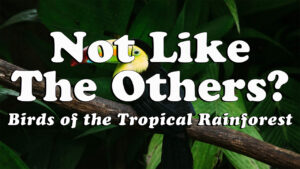
Not Like The Others: Birds of the Tropical Rainforest
Which of these four birds is not like the others?

Not Like The Others: Branches of the US Government
How is each part of the United States Government not like the other parts?

New Uses for a Paperclip
So what are some new ways to use a paperclip?

Writing About Art: The Scream
Your students will turn the iconic painting The Scream into a vivid, sensory poem.
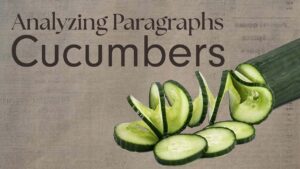
Analyze Paragraphs: Cucumbers
Three paragraphs about cucumbers. They all cover the same topic — so what makes each one different? Now combine them into one super-paragraph.
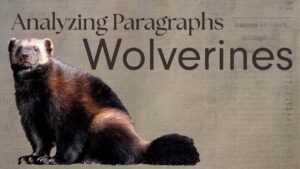
Analyze Paragraphs: Wolverines
Three paragraphs about wolverines. They all cover the same topic — so what makes each one different? Now combine them into one super-paragraph.

Inferring With Art: Two Women
What are these two women up to? What’s that thing she’s holding? Let’s make some inferences!

Self Portraits: Text Art
What if a students’ self-portrait was made of words that describe the student!?

Self Portraits Part One: Line Drawings
Anyone, yes anyone, can create a (somewhat) realistic self-portrait using these steps. Anyone!

Not Like The Others: Natural Disasters
Four natural disasters. One doesn’t belong. But which one? That depends on your argument.
Changing Coordinating Conjunctions
What happens when we switch out a “but” with a “so”? An “and” with a “for”? How can such tiny words make such big differences?

Fixing Shakespearean Run-Ons
Can your students help The Bard? We’ll fix five Shakespearean run-ons in three different ways.

Not Like The Others: States of Matter
How is each of the states of matter not like the others?

Notice, Wonder: A Long Line
A mysterious image. Reveal it slowly. Let your students wonder!
Writing A Thanksgiving Letter
What if an inanimate object could express thanks for a special person in your life? What would it write?

Punctuation Power
In a sentence, punctuation may seem meek when compared to those mighty words, but punctuation has incredible power over the meaning of a sentence. Students will try re-punctuating sentences to find new meanings – without changing a single word!

What’s In My Brain: May vs May
The word “may” can be used for possibility or permission. It’s a modal auxiliary verb!

Paragraphs: Systems of Sentences
Blow up a paragraph into individual sentences. Now reassemble it. The clues hiding in each sentence will surprise you.

The Personalities of Rocks
What would an igneous rock be like? Would it get along with a sedimentary rock? Could they handle the hot personality of a metamorphic rock?

Notice, Wonder: A Ship
A mysterious image. Reveal it slowly. Let your students wonder!

Run On or Not? – What’s In My Brain
Can your students spot the run-on sentences?
Parts of Speech Party – Thanks
How many different ways can we use the word “thanks”? Let’s find out in this Parts of Speech Party!

Paradox: The Liar’s Paradox
Nothing like a paradox to get your kids brains exploding 🤯! This one starts with five simple words: “This statement is a lie.”

More Specific than “Smart”
When students are told that they’re “smart”, what does this word actually mean to them? (Psst. It isn’t what we intended.)
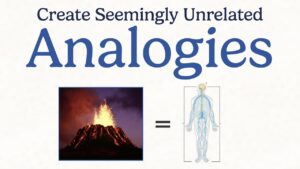
Building Creative Analogies
We’ll take two seemingly unrelated pieces of content (say volcanoes and the human body) and then build analogies to connect the two ideas. In the end, students can create a skit, comic, or story relating the two concepts.

Describing Author’s Voice
What if… Edgar Allen Poe wrote Alice’s Adventures in Wonderland?

Synonym Graphs
So, which is happiest: happy, joyful, or ecstatic? Which is most temporary?

Passive to Active Voice
In this lesson, students will not just fix passive sentences, but break active sentences as they learn to put the star of the sentence first.

Improving Presentations 1: Watching The Greats
Get better at giving presentations by studying the greats!

Analyze Character Change with Depth and Complexity
Your students will use Depth and Complexity to note how a character’s main trait changes across a story.

Creating A Realistic Flower and Pollinator
Your students will create a new flower, designed to attract a specific pollinator.

“Its Big Day” – A Children’s Story About Its and It’s
Let’s spice up a typically dull lesson about the difference between “its” and “it’s” by asking students to write a children’s story about the adventures of a critter named It.

Create A Creature
Create a new creature based on the adaptations of existing creatures from the same biome.

Ways to Start a Sentence – Part 3
Your students’ sentences all start the same way. Here are three techniques that fix that overnight.

Ways to Start a Sentence – Level 2
We’ll show students how to add more variety to their writing by starting sentences with a reason, a prepositional phrase, and a simile.

Ways to Start a Sentence – Level 1
‘Add more variety!’ teachers say. But how? This lesson gives students actual techniques instead of vague advice.

Greekymon
Rather than just memorizing word parts, students will use those word parts to create four possible products.

Writing Clear Directions
Can you write directions so clear that a group of kids can put a toy together with no illustrations?