


Writing Lessons

Holiday Shuffle – Day vs Date
Wouldn’t some holidays be better on a certain day of the week? Should Thanksgiving have a set date?

Bobbing for Apples
What is bobbing for apples like… for an apple?

A Halloween Costume Gone Wrong
Let’s go roller skating in a Halloween costume! What could possibly go wrong?

Robot Writing: Volcano
Read three pieces of writing from three different robots about the same beautiful painting of a volcano. Who wrote it best?

Robot Writing: Acropolis
One painting of ruins. Three robots. Three pieces of writing. Who wrote it best?

Robot Writing: The Bridge
One painting of a bridge. Three robots. Who wrote it best?

Robot Writing: Orchestra
Read three pieces of writing from three different robots based on a beautiful painting and decide who wins!

Think Like An Author: Hemingway vs Dickens
What if your students rewrote Dickens in the style of Hemingway and vice versa?

Random Emoji Prompt Generator
Click up an interesting, visual writing prompt suitable for any grade or purpose.

Lipogram: Rewrite “Mary Had A Little Lamb”
What if we rewrote a piece of writing without using certain letters?

Lipogram: Rewrite “Twinkle, Twinkle”
What if we rewrote a piece of writing without using certain letters?

Looking Closely at Holiday Photos
Let’s write from multiple perspectives using an old timey holiday photo!

Holiday Writing: Packing Crates
An old photograph. A holiday scene. Pick one object in the picture and write from its point of view.

Thanksgiving Photo Writing
Starting with an old-timey photo, students will write from a particular item’s point of view.

Writing About Art: Burning of the Houses of Lords and Commons
Look closely at Burning of the Houses of Lords and Commons. What do you notice? Now turn those details into a poem you didn’t know you could write.

Writing About Art: Impression, Sunrise
Look closely at Impression, Sunrise. What do you notice? Now turn those details into a poem you didn’t know you could write.

Writing in Pilish
Pi can go beyond circles! What if you wrote using the digits of pi as your guide?

Writing About Art: Chōshi in Shimosha
Get your students writing some pretty darn impressive poetry based on Japan’s most famous artist.

Writing About Art: Wanderer Above the Sea of Fog
Look closely at Wanderer Above the Sea of Fog. What do you notice? Now turn those details into a poem you didn’t know you could write.

Writing About Art: Twilight in the Wilderness
Look closely at Twilight in the Wilderness. What do you notice? Now turn those details into a poem you didn’t know you could write.

Fancier Figurative Language: Use the Opposite
Let’s start with “As cold as fire.”

Fancier Figurative Language: Move the Simile
What if we started a sentence with the simile?

Writing About Art: The Scream
Your students will turn the iconic painting The Scream into a vivid, sensory poem.
Analyze Paragraphs: Baseball
Three paragraphs about baseball. They all cover the same topic — so what makes each one different? Now combine them into one super-paragraph.
Analyze Paragraphs: Cucumbers
Three paragraphs about cucumbers. They all cover the same topic — so what makes each one different? Now combine them into one super-paragraph.
Analyze Paragraphs: Empire State Building
Three paragraphs about the Empire State Building. They all cover the same topic — so what makes each one different? Now combine them into one super-paragraph.
Analyze Paragraphs: Tomatoes
Three paragraphs about tomatoes. They all cover the same topic — so what makes each one different? Now combine them into one super-paragraph.
Analyze Paragraphs: Wolverines
Three paragraphs about wolverines. They all cover the same topic — so what makes each one different? Now combine them into one super-paragraph.
Changing Coordinating Conjunctions
What happens when we switch out a “but” with a “so”? An “and” with a “for”? How can such tiny words make such big differences?
Writing A Thanksgiving Letter
What if an inanimate object could express thanks for a special person in your life? What would it write?

Ambiguous Sentences
Rather than just demand that students “write clearly,” we’ll explore the hazards of poorly written sentences… and maybe create one of our own!

Punctuation Power
In a sentence, punctuation may seem meek when compared to those mighty words, but punctuation has incredible power over the meaning of a sentence. Students will try re-punctuating sentences to find new meanings – without changing a single word!

Fancier Figurative Language: Advanced Repetition
Is your students’ use of repetition limited to, “The girl was very, very, very fast.”? Let’s borrow some ideas from Shakespeare!
Upgrading Compare and Contrast Writing
Upgrade compare and contrast writing with just a couple of key words.
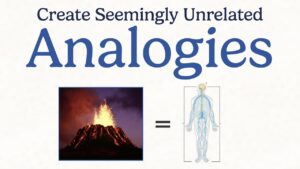
Building Creative Analogies
We’ll take two seemingly unrelated pieces of content (say volcanoes and the human body) and then build analogies to connect the two ideas. In the end, students can create a skit, comic, or story relating the two concepts.

Describing Author’s Voice
What if… Edgar Allen Poe wrote Alice’s Adventures in Wonderland?

Passive to Active Voice
In this lesson, students will not just fix passive sentences, but break active sentences as they learn to put the star of the sentence first.

Showing A Character’s Trait
We tell students to ‘show, not tell’ — but that advice is useless until they experience the difference. This lesson makes it click.

Academic Love Letters
What if Kylo Ren wrote a love letter to Abe Lincoln or the Sahara Desert wrote one to the Moon?

Elements of The Fantasy Genre
Every fantasy story has patterns hiding underneath the magic. Once your students see the elements, they’ll spot them everywhere — and use them in their own writing.

Literary Technique: Juxtaposition
Put a grumpy character next to a joyful one and they make each other stand out even more. Opposites are powerful!

Ways to Start a Sentence – Part 3
Your students’ sentences all start the same way. Here are three techniques that fix that overnight.

Ways to Start a Sentence – Level 2
We’ll show students how to add more variety to their writing by starting sentences with a reason, a prepositional phrase, and a simile.

Ways to Start a Sentence – Level 1
‘Add more variety!’ teachers say. But how? This lesson gives students actual techniques instead of vague advice.

Writing Summaries in Haiku
Let’s write a summary. A very short summary. With VERY strict rules.

Teach Non-Fiction Writing Structure With Fractals
Did you ever notice that the structure of an essay is very similar to the structure of a paragraph? Hmm…

Fancier Figurative Language: Start with a Cliche
We’ll start with the cliché “as cold as ice” and go somewhere much more interesting.

Writing Clear Directions
Can you write directions so clear that a group of kids can put a toy together with no illustrations?

Better Stories Part 5: Plot Structure
Ever read a student’s story that was just event after event after event and then a very sudden ending? They lack an understanding of a plot’s structure. With the help of Finding Nemo, I break down how to set up a well-structured plot.

Better Stories Part 2: Types of Conflict
If your students’ stories are packed with endless ninja fights or arguments between frenemies, it’s time to expose them to a wider range of conflicts.

Better Stories Part 3: Literary Themes
A typical student narrative includes plot and characters but lacks a larger idea to hold it all together. This is where a lesson on themes comes in…

Better Stories Part 1: The Big Idea
We open our unit on narrative writing with a big idea: “structure increases creativity.” I show how this is true by bringing in examples from across all disciplines.

Better Stories Part 4: Character Archetypes
Are students’ characters a bit flat? Archetypes give them a strong foundation on which to build their own characters as well as a tool to analyze existing stories.