


Playlist: Bookmarks

Pyrostasis (Greek and Latin)
What on earth is a Pyrostasis? Break apart the Greek and Latin roots, figure out what it should mean, then invent what it describes.

Crossing Every Bridge Exactly Once (aka Eulerian Paths)
How can you cross each bridge in this city exactly once?
Parts of Speech Party – Gift
How many different ways can we use the word “gift” in a single paragraph? Let’s find out in this Parts of Speech Party!

Parts of Speech Party – Care
How many different ways can we use the word “care”? Let’s find out in this Parts of Speech Party!
Parts of Speech Party – Fruit
How many different ways can we use the word “fruit”? Let’s find out in this Parts of Speech Party!
Parts of Speech Party – Change
How many different ways can we use the word “change”? Let’s find out in this Parts of Speech Party!
Parts of Speech Party: Introduction (Check)
How many ways can we use “check” in a paragraph? And can your students spot when it’s a verb, or a noun, or an adjective?

Analyze Suffixes: -en
What exactly does adding -en to a word do? Find the pattern. Then find the words that break it.

Lipogram: Rewrite “Twinkle, Twinkle”
What if we rewrote a piece of writing without using certain letters?

Categorize and Re-Categorize Animals
Put these animals into groups. Then do it again. Then… do it one more time. How does re-re-grouping the same creatures reveal new patterns and give new insights?

Special Gifts with Special Requirements
Your special friends sure have some unique gift needs!

Analyze Suffixes: -ly, -less, and -ful
What exactly does adding -less do to a word?

Exploration Technology Tournament
Which of these pieces of exploration technology is most important? Most underrated? Most long-lasting?

Greek and Latin Word Part Paths
How can we go from Biology to Immobile?

Tournament of Ancient Inventions
Which of these inventions of the ancient world is most influential? Least useful today? Most taken-for-granted?

Parts of Speech Tournament
Which part of speech is most useful? Interesting? Strange?

New Uses for a Paperclip
So what are some new ways to use a paperclip?

Think Like A Historian
Here’s how effects be causes and causes can be effects!

Analyze Characters Using Philosophy
What is the Brick Pig’s philosophy? How would he apply it to the characters in Harry Potter?

A Lunar Survival Mission
A favorite of mine! This task is delightfully complex and ambiguous, forcing students to make choices without enough information and with no right answer. How will they survive on the moon for three days?
Changing Coordinating Conjunctions
What happens when we switch out a “but” with a “so”? An “and” with a “for”? How can such tiny words make such big differences?

Characters Dressed as Other Characters for Halloween
What if one character dressed up as another for Halloween? Would the Cat in the Hat pick Captain Jack Sparrow, because they’re both chaotic yet good-natured people? Would Elsa dress up as The Ice King since they are both lonely?

Virtue or Vice?
Aristotle noted that positive traits and negative traits are often the same thing, but just in different amounts. The right amount is a virtue, but too much or too little and it’s a vice.

Punctuation Power
In a sentence, punctuation may seem meek when compared to those mighty words, but punctuation has incredible power over the meaning of a sentence. Students will try re-punctuating sentences to find new meanings – without changing a single word!

What’s In My Brain: May vs May
The word “may” can be used for possibility or permission. It’s a modal auxiliary verb!

Plurals: An Inductive Spelling Lesson
Plural nouns in English are deliciously fascinating. Yet most plural lessons are so dull! In this experience, students are given a pile of plurals and then inductively create groups and pull out rules and patterns.

Paragraphs: Systems of Sentences
Blow up a paragraph into individual sentences. Now reassemble it. The clues hiding in each sentence will surprise you.
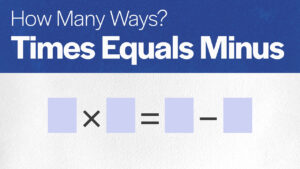
How Many Ways: Times Equals Minus
How many different ways can you make this math statement true using only the digits one through nine?

What’s In My Brain: Painting vs Painting
Two columns of sentences. Something is different about them. Can you figure out the rule?

Writing A Story About Fraction Equivalence
When fractions take on a new denominator, it’s as if they’re wearing a disguise – same value, new look. So let’s write a story about fraction equivalence starring a fraction who needs to fit in with a new group.

Ghost
Ghost is a word-building game for two players. The first person to create an actual word loses.

Same Perimeter, Different Area For Rectangles
Can two rectangles have the same perimeter but… different areas!?

What’s In My Brain – Independent vs Dependent
These clauses are sorted into two groups. What’s the rule? No definitions given — just examples.

Simple or Compound Sentences – What’s In My Brain?
Can your students spot simple sentences vs compound sentences?

Complex or Compound – What’s In My Brain
Can your class spot the complex sentences vs compound sentences?

Sets of Idioms
Why do we say ‘break a leg’? Five themed sets of idioms your students will actually remember.

What’s In My Brain: Progressive vs Simple Tenses
Will your students notice progressive tense vs simple tense?

What’s In My Brain – The Park vs The Museum
We’re looking at the past progressive tense and the simple past tense.
Parts of Speech Party – Well
How many different ways can we use the word “well”? Let’s find out in this Parts of Speech Party!
Parts of Speech Party – Thanks
How many different ways can we use the word “thanks”? Let’s find out in this Parts of Speech Party!
Parts of Speech Party – Limit
How many different ways can we use the word “limit”? Let’s find out in this Parts of Speech Party!

Math Curiosity: The Coloring Problem
No video gets me more email from students! How few colors can you use to color in any map so that no two, neighboring regions are the same color?

Pronouns With Too Many Antecedents
What happens when a pronoun could refer to more than one noun? Big problems!
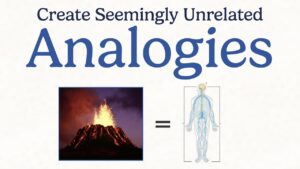
Building Creative Analogies
We’ll take two seemingly unrelated pieces of content (say volcanoes and the human body) and then build analogies to connect the two ideas. In the end, students can create a skit, comic, or story relating the two concepts.

Describing Author’s Voice
What if… Edgar Allen Poe wrote Alice’s Adventures in Wonderland?

Synonym Graphs
So, which is happiest: happy, joyful, or ecstatic? Which is most temporary?

Passive to Active Voice
In this lesson, students will not just fix passive sentences, but break active sentences as they learn to put the star of the sentence first.

Showing A Character’s Trait
We tell students to ‘show, not tell’ — but that advice is useless until they experience the difference. This lesson makes it click.

Multiple Meaning Matcher – Introduction
Your students will try to match up definitions that belong to the same homophone in this brain-boggling vocab puzzle.

Studying and Remixing “The Raven”
Ready to push kids beyond the boring, old ABAB rhyme scheme and into something a bit more complex?

Analyze Character Change with Depth and Complexity
Your students will use Depth and Complexity to note how a character’s main trait changes across a story.

“Its Big Day” – A Children’s Story About Its and It’s
Let’s spice up a typically dull lesson about the difference between “its” and “it’s” by asking students to write a children’s story about the adventures of a critter named It.

Ways to Start a Sentence – Part 3
Your students’ sentences all start the same way. Here are three techniques that fix that overnight.

Ways to Start a Sentence – Level 2
We’ll show students how to add more variety to their writing by starting sentences with a reason, a prepositional phrase, and a simile.

Ways to Start a Sentence – Level 1
‘Add more variety!’ teachers say. But how? This lesson gives students actual techniques instead of vague advice.

Greekymon
Rather than just memorizing word parts, students will use those word parts to create four possible products.

Writing Summaries in Haiku
Let’s write a summary. A very short summary. With VERY strict rules.

Better Stories Part 5: Plot Structure
Ever read a student’s story that was just event after event after event and then a very sudden ending? They lack an understanding of a plot’s structure. With the help of Finding Nemo, I break down how to set up a well-structured plot.

Greek and Latin Dinosaur Names
Let’s create a new dinosaur using Greek and Latin stems!

Think Like An Economist
How would an economist read Goldilocks? How would they see a rainforest? How would they study the American Revolution?