


Playlist: Bookmarks
Contig
Roll three dice and combine them using any mathematical operation. But be strategic to maximize your points!

Comparing Characters’ Bedrooms
What item’s in a character’s bedroom would reflect their deepest desires? And what if they toured a similar character’s room?

Going Beyond “Name That Genre!”
For TeachersNaming the genre is step one. But what comes after that? Here’s how to push students past identification into real analysis.

Create A Civ: Capital City
Every great capital is part geography, part human design. Research real ones, then build your own from scratch.

Words Within Words: Intro (SOLDIER)
How many words can you find within SOLDIER? 20? 35? 50? Even more!?

Think Like An Author: Hemingway vs Dickens
What if your students rewrote Dickens in the style of Hemingway and vice versa?
Depth and Complexity and Graphic Organizers
For TeachersLet’s see a few examples of how Depth and Complexity slides nicely into any graphic organizer.

Graphic Organizers and Higher Order Thinking
For TeachersA few quick tips on how to better use graphic organizers to support higher-order thinking.

Lipogram: Rewrite “Twinkle, Twinkle”
What if we rewrote a piece of writing without using certain letters?
Making Depth and Complexity Posters
Why buy premade posters when you can show off your students’ thinking about Depth and Complexity?

Racetrack – Race Around A Graph
How fast do you get your mathematical car going without crashing?

Parabolic Curve Art
Create mathematical art with curves that, well, aren’t curvy.

Habitable Planets and Moons Tournament
Which object in the solar system is most habitable?

Create A Civilization: Design A Flag
What makes for a good flag? What makes a bad flag?

Antonym Paths
Does the antonym of an antonym bring us back to the same meaning?

A Lunar Survival Mission
A favorite of mine! This task is delightfully complex and ambiguous, forcing students to make choices without enough information and with no right answer. How will they survive on the moon for three days?

Doubling Up Writing: Anadiplosis
Repeating words can be what you want, if what you want is an interesting effect. (Psst, that’s an example of anadiplosis!)

Writing Technique: 3 Dependent Clauses
A specific technique to help students add some spice to their writing. We’ll be writing sentences with three dependent clauses.

Word Ladders Introduction
You won’t believe how this spelling and vocabulary puzzle will get kids’ brains sweating over the smallest of words.

Math Curiosity: A Pattern Packed Triangle
Pascal’s pattern-packed triangle is a potent puzzle for pupils to ponder.

Think Like A Philosopher
What would Socrates have thought if he watched Frozen?

Virtue or Vice?
Aristotle noted that positive traits and negative traits are often the same thing, but just in different amounts. The right amount is a virtue, but too much or too little and it’s a vice.

SCAMPER: Scaffolding Creativity
Asking students to “think creatively” won’t get you far. They won’t know how to start, they’ll get stuck with simple ideas, or they’ll just go completely wild. SCAMPER is a tool for scaffolding the process of creativity.

Writing Seuss Style Poetry
Sure, Dr. Seuss wrote for young students, but can older students analyze his writing and learn to mimic his style? THEN, they can produce Seuss-style poetry about any topic: Ancient China, the electromagnetic spectrum, Pride and Prejudice, and (yes) fraction division!

Paragraphs: Systems of Sentences
Blow up a paragraph into individual sentences. Now reassemble it. The clues hiding in each sentence will surprise you.

Fancier Figurative Language: Advanced Repetition
Is your students’ use of repetition limited to, “The girl was very, very, very fast.”? Let’s borrow some ideas from Shakespeare!

Writing Sample: Moby Dick
A passage from Moby Dick to use as a mentor text, discussion starter, or writing prompt.

Upgrade Research Questions With Depth and Complexity
Ever ask students to create research questions? Were their ideas a bit… blah? My own students had a very hard time writing questions they didn’t already know the answer to! This video is how I solved that problem: upgrade research questions with depth and complexity.

Paradox: The Liar’s Paradox
Nothing like a paradox to get your kids brains exploding 🤯! This one starts with five simple words: “This statement is a lie.”

Game: Notakto
What if you only played Tic-Tac-Toe with Xs and you could play on multiple boards?

The Resiliency Tournament
Your students will set up a tournament to determine which person or character best demonstrated resiliency.

Analyzing Movies’ Success
So should we make another movie in this series?
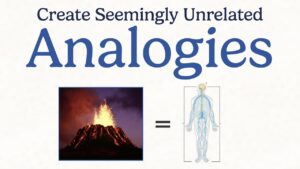
Building Creative Analogies
We’ll take two seemingly unrelated pieces of content (say volcanoes and the human body) and then build analogies to connect the two ideas. In the end, students can create a skit, comic, or story relating the two concepts.

Synonym Graphs
So, which is happiest: happy, joyful, or ecstatic? Which is most temporary?

Math Curiosity: Odds & Squares
Why does the sum of the first 5 odds also equal 5 squared?

The Thinking Hats
So… do your students moan when forced to work in a group? Part of the problem is that lack the structure to work well with peers. Edward de Bono’s Thinking Hats are a perfect tool to help with this problem.

A Donut Investigation
In this cross-curricular investigation, students will look into an intriguing question: do donuts or salads have more sugar? They’ll grapple with misleading information, bias, and use their math skills to create a visual representation of sugar in popular foods.

Jabberwocky and Context Clues
Context clues lessons can be a disaster. Here, we expose students to a delightful classic packed with nonsense words (“Jabberwocky”) and ask them to decipher the meanings and parts of speech. Then, it’s only natural for students to write their own nonsense poems.

Showing A Character’s Trait
We tell students to ‘show, not tell’ — but that advice is useless until they experience the difference. This lesson makes it click.

Improving Presentations 3: The Storyboard and Slides
It’s time to turn that outline into a storyboard and then some actual slides.

Improving Presentations 1: Watching The Greats
Get better at giving presentations by studying the greats!

Math Curiosity: Finding Primes
Prime numbers are unpredictable! How can we possibly find them all? An Ancient Greek mathematician found one way!

Content Imperatives: Paradox
How can one idea pull in opposite directions, being both true and false or right and wrong at the same time? It’s time to explore Paradoxes!

Content Imperatives: Parallel
Get students thinking broadly by exploring similarities across multiple topics. Combine with Depth and Complexity for bonus points!

Content Imperatives: Contribuition
Pull on one thread and watch the whole topic move. Contribution asks: what single factor is quietly shaping everything else?

Depth and Complexity: ⚖️ Ethics
Want to add drama to any topic? Use the Ethics prompt!

Depth and Complexity: Patterns
Can your students spot anything that repeats? Or that has stopped repeating?

Analyze Character Change with Depth and Complexity
Your students will use Depth and Complexity to note how a character’s main trait changes across a story.

Analyze and Create Misleading Graphs
Let’s make some intentionally bad graphs to learn how to spot poorly made graphs.

Literary Technique: Juxtaposition
Put a grumpy character next to a joyful one and they make each other stand out even more. Opposites are powerful!

Math Curiosity: Palindromic Number Conjecture
Using this one weird trick, it seems that you can turn any number into a palindrome!

Greekymon
Rather than just memorizing word parts, students will use those word parts to create four possible products.

Better Stories Part 5: Plot Structure
Ever read a student’s story that was just event after event after event and then a very sudden ending? They lack an understanding of a plot’s structure. With the help of Finding Nemo, I break down how to set up a well-structured plot.

Better Stories Part 1: The Big Idea
We open our unit on narrative writing with a big idea: “structure increases creativity.” I show how this is true by bringing in examples from across all disciplines.

Better Stories Part 4: Character Archetypes
Are students’ characters a bit flat? Archetypes give them a strong foundation on which to build their own characters as well as a tool to analyze existing stories.