


Playlist: Bookmarks

From Summary to Synthesis
For TeachersHere’s how you can move from merely “summarizing a text” to a high-level task that culminates in synthesis.

Phrases to Join a Discussion
Want your classroom discussions to go a bit more smoothly? Train students to use a few simple phrases and it’ll make all the difference in the world.

Special Gifts with Special Requirements
Your special friends sure have some unique gift needs!

Investigating Population Changes
How have the ages of three countries’ populations changed from 1950 to 2020? And what problems might that create?

Introducing Universal Theme of Change
Everything changes. But how does it change? Students brainstorm dozens of examples and boil them down to one big idea.
Introducing Universal Theme of Power
So what could you do with a Universal Theme of Power? Well, here’s an introduction that will get your students’ brains sweating.

Writing in Pilish
Pi can go beyond circles! What if you wrote using the digits of pi as your guide?

Not Like The Others: Snakes of the Rainforest
Four rainforest snakes. One doesn’t belong. But which one? That depends on your argument.

Looping Grid Art
Pick a few numbers, draw some corresponding lines on grid paper, and you’ll end up with some interesting, looping math-y art!

Remixing A Holiday Poem
Let’s take a classic Christmas poem and remix it to work with another holiday!

Evens and Odds – Addition and Subtraction
When we’re adding and subtracting, do evens make odds into evens? Do odds make evens odd? Which one has… more power!?
Invisible Power Can Have Visible Effects
Can you think of times when power is unseen, but we can clearly see its effects?

Punctuation Power
In a sentence, punctuation may seem meek when compared to those mighty words, but punctuation has incredible power over the meaning of a sentence. Students will try re-punctuating sentences to find new meanings – without changing a single word!

Numerator or Denominator: Which has more power in a fraction?
What do you do with students who already get their fraction operations? Give them a contrived project about recipes or pizza slices? Make them solve annoyingly hard practice problems? Please. Here, we get students thinking in a whole new way, pondering which has more power, the numerator or denominator.

Do Narrators Have Too Much Power?
Imagine being a character in a story. Are you worried that your story’s narrator may inaccurately describe you? What if they reveal something you wanted to be kept secret? Do narrators have too much power!?

Student Introductions with Complexity and Frames
How have you changed over time? Students introduce themselves through the lens of change — and learn a Depth and Complexity tool in the process.
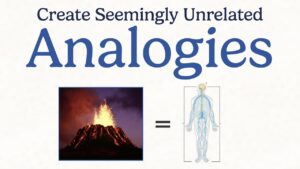
Building Creative Analogies
We’ll take two seemingly unrelated pieces of content (say volcanoes and the human body) and then build analogies to connect the two ideas. In the end, students can create a skit, comic, or story relating the two concepts.

Synonym Graphs
So, which is happiest: happy, joyful, or ecstatic? Which is most temporary?

The Thinking Hats
So… do your students moan when forced to work in a group? Part of the problem is that lack the structure to work well with peers. Edward de Bono’s Thinking Hats are a perfect tool to help with this problem.

A Donut Investigation
In this cross-curricular investigation, students will look into an intriguing question: do donuts or salads have more sugar? They’ll grapple with misleading information, bias, and use their math skills to create a visual representation of sugar in popular foods.

What Do Mean and Median Mean?
When will mean and median give us different results?

Persuasion and Packaging: Ethos, Pathos, and Logos
How does a drink’s packaging affect us emotionally and logically?

Analyze Character Change with Depth and Complexity
Your students will use Depth and Complexity to note how a character’s main trait changes across a story.

Creating A Realistic Flower and Pollinator
Your students will create a new flower, designed to attract a specific pollinator.

Analyze and Create Misleading Graphs
Let’s make some intentionally bad graphs to learn how to spot poorly made graphs.

Greekymon
Rather than just memorizing word parts, students will use those word parts to create four possible products.

Better Stories Part 1: The Big Idea
We open our unit on narrative writing with a big idea: “structure increases creativity.” I show how this is true by bringing in examples from across all disciplines.