


Playlist: Bookmarks

Change A Story’s Genre
What if we rewrote a story’s climax into a totally different genre?
Parts of Speech Party: Introduction (Check)
How many ways can we use “check” in a paragraph? And can your students spot when it’s a verb, or a noun, or an adjective?

Greek and Latin Word Part Paths
How can we go from Biology to Immobile?

Writing in Pilish
Pi can go beyond circles! What if you wrote using the digits of pi as your guide?

Antonym Paths
Does the antonym of an antonym bring us back to the same meaning?

Fancier Figurative Language: Use the Opposite
Let’s start with “As cold as fire.”

Think Like A Historian
Here’s how effects be causes and causes can be effects!
Changing Coordinating Conjunctions
What happens when we switch out a “but” with a “so”? An “and” with a “for”? How can such tiny words make such big differences?

Doubling Up Writing: Anadiplosis
Repeating words can be what you want, if what you want is an interesting effect. (Psst, that’s an example of anadiplosis!)

Jotto
Who can guess the codeword first?

Writing Technique: Opposite Adjectives
A specific technique to help students add some spice to their writing. We’ll be using antonyms to describe the same topic!
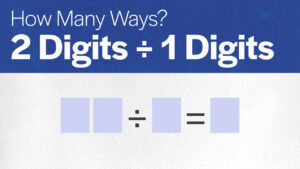
How Many Ways: 2 Digits ÷ 1 Digit = 1 Digit
How many different ways can you make this math statement true using only the digits one through nine?

Advanced Alliteration and Consonance
When students learn about alliteration, it’s hard to steer them away from goofy tongue-twisters. Certainly, there must be more powerful and practical ways of using alliteration. In this lesson, I draw on delicious examples from Shakespeare to show how a very advanced writer used alliteration. Then, I break those ideas down so students can try them out.

What’s In My Brain: Painting vs Painting
Two columns of sentences. Something is different about them. Can you figure out the rule?

Student Introductions With Depth and Frames
Want to introduce the tools of Depth and Complexity and learn more about your students and introduce the Frame graphic organizer? Have I got the activity for you!

Math Curiosity: The Coloring Problem
No video gets me more email from students! How few colors can you use to color in any map so that no two, neighboring regions are the same color?
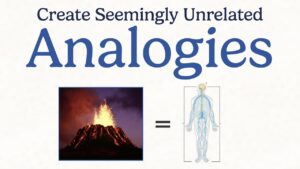
Building Creative Analogies
We’ll take two seemingly unrelated pieces of content (say volcanoes and the human body) and then build analogies to connect the two ideas. In the end, students can create a skit, comic, or story relating the two concepts.
What Does it Cost to Fill a Car with Other Liquids
Is gas actually that expensive? What if we filled a car up with… orange juice?

Fractals: Sierpinski’s Triangle
What if this triangle pattern just kept repeating… forever!?

A Donut Investigation
In this cross-curricular investigation, students will look into an intriguing question: do donuts or salads have more sugar? They’ll grapple with misleading information, bias, and use their math skills to create a visual representation of sugar in popular foods.

Math Curiosity: Waring’s Conjecture
So, can you write every odd (greater than 3) as the sum of three primes?

Differentiate With Frames Across Disciplines
For TeachersOne topic, four angles. The Frame graphic organizer gives every student a different way in — without you creating four different lessons.

Analyze Character Change with Depth and Complexity
Your students will use Depth and Complexity to note how a character’s main trait changes across a story.

Educational Valentines
Let’s make valentines with an educational twist!

Introduce Symbolism with Pixel Art
Create a pixelated icon that represents the essence of a character!

Analyze and Create Misleading Graphs
Let’s make some intentionally bad graphs to learn how to spot poorly made graphs.

Literary Technique: Juxtaposition
Put a grumpy character next to a joyful one and they make each other stand out even more. Opposites are powerful!