


Playlist: Bookmarks

Greekymon Studies – Round 2
What might a creature named “Hypermnemonicus” be like?

Greekymon Studies – Round 1
What might a creature named “Ursolunascope” be like?

Multiple Meaning Matcher – Theta
Can your students match multiple meanings of the same five words?

Multiple Meaning Matcher – Alpha
Can your students match multiple meanings of the same five words?
Parts of Speech Party: Introduction (Check)
How many ways can we use “check” in a paragraph? And can your students spot when it’s a verb, or a noun, or an adjective?

Back to School: Rewriting The Beatles’ “Help!”
Can your students come up with a one-syllable word to sum up their time away from school? And then rewrite The Beatles’ song Help!?

Analyze Suffixes: -ly, -less, and -ful
What exactly does adding -less do to a word?

Greek and Latin Word Part Paths
How can we go from Biology to Immobile?

Writing About Art: Chōshi in Shimosha
Get your students writing some pretty darn impressive poetry based on Japan’s most famous artist.

Antonym Paths
Does the antonym of an antonym bring us back to the same meaning?
Changing Coordinating Conjunctions
What happens when we switch out a “but” with a “so”? An “and” with a “for”? How can such tiny words make such big differences?

Punctuation Power
In a sentence, punctuation may seem meek when compared to those mighty words, but punctuation has incredible power over the meaning of a sentence. Students will try re-punctuating sentences to find new meanings – without changing a single word!

Writing Seuss Style Poetry
Sure, Dr. Seuss wrote for young students, but can older students analyze his writing and learn to mimic his style? THEN, they can produce Seuss-style poetry about any topic: Ancient China, the electromagnetic spectrum, Pride and Prejudice, and (yes) fraction division!

Paragraphs: Systems of Sentences
Blow up a paragraph into individual sentences. Now reassemble it. The clues hiding in each sentence will surprise you.

What’s In My Brain – Independent vs Dependent
These clauses are sorted into two groups. What’s the rule? No definitions given — just examples.

Simple or Compound Sentences – What’s In My Brain?
Can your students spot simple sentences vs compound sentences?

Run On or Not? – What’s In My Brain
Can your students spot the run-on sentences?

Complex or Compound – What’s In My Brain
Can your class spot the complex sentences vs compound sentences?
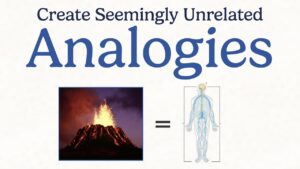
Building Creative Analogies
We’ll take two seemingly unrelated pieces of content (say volcanoes and the human body) and then build analogies to connect the two ideas. In the end, students can create a skit, comic, or story relating the two concepts.

Synonym Graphs
So, which is happiest: happy, joyful, or ecstatic? Which is most temporary?

Jabberwocky and Context Clues
Context clues lessons can be a disaster. Here, we expose students to a delightful classic packed with nonsense words (“Jabberwocky”) and ask them to decipher the meanings and parts of speech. Then, it’s only natural for students to write their own nonsense poems.

Showing A Character’s Trait
We tell students to ‘show, not tell’ — but that advice is useless until they experience the difference. This lesson makes it click.

Multiple Meaning Matcher – Introduction
Your students will try to match up definitions that belong to the same homophone in this brain-boggling vocab puzzle.

Improving Presentations 1: Watching The Greats
Get better at giving presentations by studying the greats!

Academic Love Letters
What if Kylo Ren wrote a love letter to Abe Lincoln or the Sahara Desert wrote one to the Moon?

Analyze Character Change with Depth and Complexity
Your students will use Depth and Complexity to note how a character’s main trait changes across a story.

Ways to Start a Sentence – Part 3
Your students’ sentences all start the same way. Here are three techniques that fix that overnight.

Ways to Start a Sentence – Level 2
We’ll show students how to add more variety to their writing by starting sentences with a reason, a prepositional phrase, and a simile.

Ways to Start a Sentence – Level 1
‘Add more variety!’ teachers say. But how? This lesson gives students actual techniques instead of vague advice.

Greekymon
Rather than just memorizing word parts, students will use those word parts to create four possible products.

Fancier Figurative Language: Start with a Cliche
We’ll start with the cliché “as cold as ice” and go somewhere much more interesting.

Greek and Latin Dinosaur Names
Let’s create a new dinosaur using Greek and Latin stems!