


Playlist: Bookmarks

What’s In My Brain: Crocodile vs Tree Frog
Is it a reptile or an amphibian?

Van Gogh on Water
Oil paint floats on water and becomes a familiar scene.

Crossing Every Bridge Exactly Once (aka Eulerian Paths)
How can you cross each bridge in this city exactly once?

Cooking In Space
Watch astronaut Samantha Cristoforetti cook a meal in zero gravity on the International Space Station.
Parts of Speech Party – Gift
How many different ways can we use the word “gift” in a single paragraph? Let’s find out in this Parts of Speech Party!

Squiggles Introduction
What do you see in this squiggle?

Squiggles Collection 1
Everyone starts with the same squiggle. No two drawings end up the same. What do you see?

Writing About Art: Impression, Sunrise
Look closely at Impression, Sunrise. What do you notice? Now turn those details into a poem you didn’t know you could write.

Fizz Buzz: A Counting and Divisibility Game
Ready for a tricky counting and divisibility game?

Concept Attainment: Art
Can your students tell the difference between cubism and abstract art?
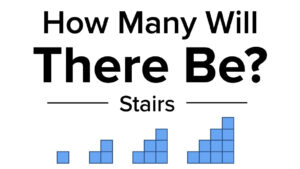
How Many Will There Be? Stairs
Give kids a taste of a sequence, let them build an understanding, and then see how far their predictions can take them.

Self Portraits: Text Art
What if a students’ self-portrait was made of words that describe the student!?

Fixing Shakespearean Run-Ons
Can your students help The Bard? We’ll fix five Shakespearean run-ons in three different ways.

Writing Technique: Contrast With Synonyms
A specific technique to help students add some spice to their writing. We’ll be contrasting two ideas using synonyms.

Paragraphs: Systems of Sentences
Blow up a paragraph into individual sentences. Now reassemble it. The clues hiding in each sentence will surprise you.

Not Like The Others: Creatures of the Tundra
Four tundra creatures. One doesn’t belong. But which one? That depends on your argument.

Advanced Alliteration and Consonance
When students learn about alliteration, it’s hard to steer them away from goofy tongue-twisters. Certainly, there must be more powerful and practical ways of using alliteration. In this lesson, I draw on delicious examples from Shakespeare to show how a very advanced writer used alliteration. Then, I break those ideas down so students can try them out.

Bulls and Cows
How quickly can you break the numeric code?

Student Introductions With Depth and Frames
Want to introduce the tools of Depth and Complexity and learn more about your students and introduce the Frame graphic organizer? Have I got the activity for you!

Improving Presentations 1: Watching The Greats
Get better at giving presentations by studying the greats!

Depth and Complexity: ❓ Unanswered Questions
This underutilized tool focuses students on what we don’t yet know and even what we can’t know.

Fraction Puzzlers: Add and Subtract Fractions To Reach A Number
You only have six digits to form three fractions. Can you combine them to get to 0?

Math Curiosity: Palindromic Number Conjecture
Using this one weird trick, it seems that you can turn any number into a palindrome!

Ways to Start a Sentence – Level 1
‘Add more variety!’ teachers say. But how? This lesson gives students actual techniques instead of vague advice.

Greekymon
Rather than just memorizing word parts, students will use those word parts to create four possible products.

A Nutrition-Based Math Project
Let’s create a parody ad attacking a surprisingly calorie-rich meal.

“Much Ado About Nothing” Summary
Shakespeare’s Much Ado summarized in just five minutes!

Hamlet Summary
It’s Hamlet in just about five minutes!