


Playlist: Bookmarks

What’s In My Brain: Pentagon vs Pentagon
We’re looking at regular vs irregular polygons.

Student Introductions With Depth, Complexity, and Frames: Level Two
Once students know the prompts of Depth and Complexity, let’s take them much higher up Bloom’s Taxonomy.

Racetrack – Race Around A Graph
How fast do you get your mathematical car going without crashing?

A Lunar Survival Mission
A favorite of mine! This task is delightfully complex and ambiguous, forcing students to make choices without enough information and with no right answer. How will they survive on the moon for three days?
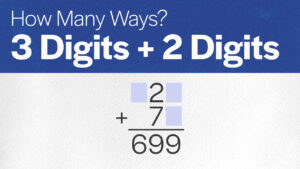
Addition: 3 Digits Plus 2 Digits (Multiple Solutions)
Typical practice problems don’t move students up Bloom’s Taxonomy. With this framework, you’ll see kids stop and really think about how to approach multi-digit addition.

Jotto
Who can guess the codeword first?

Disneyland Parking Structure Math Project
Your students will use estimation strategies to figure out how many parking spots are there in the parking structure at Disneyland? And you bet I reveal the real answer!

Parentheses: How big of a change can they make!?
Two tiny parentheses. One expression. How big of a change can they make? Bigger than you think.

Writing A Story About Fraction Equivalence
When fractions take on a new denominator, it’s as if they’re wearing a disguise – same value, new look. So let’s write a story about fraction equivalence starring a fraction who needs to fit in with a new group.

Same Perimeter, Different Area For Rectangles
Can two rectangles have the same perimeter but… different areas!?

Student Introductions With Depth and Frames
Want to introduce the tools of Depth and Complexity and learn more about your students and introduce the Frame graphic organizer? Have I got the activity for you!

Math Curiosity: The Coloring Problem
No video gets me more email from students! How few colors can you use to color in any map so that no two, neighboring regions are the same color?

Place Value (Beyond Base 10)
Place value is something we cover in elementary school. It seems simple, but I’d wager that very few adults really understand the topic. I sure didn’t until I worked with non-base-10 number systems in college. Your students can get a taste of this mind-boggling experience by imagining what it would be like if we didn’t have the number 9. What would each digit represent then?

Investigating Cost of Living
Would you save money if you lived in Las Vegas and commuted every day to San Francisco?

Doubling Dollars
Say you have a dollar. Say you can double that dollar each day: $1, $2, $4, and so on. How long will it take to reach… one million dollars? Not as long as you might think!

Fractals: Koch Snowflake
You could keep zooming in on this snowflake forever!

A Donut Investigation
In this cross-curricular investigation, students will look into an intriguing question: do donuts or salads have more sugar? They’ll grapple with misleading information, bias, and use their math skills to create a visual representation of sugar in popular foods.

Analyze and Create Misleading Graphs
Let’s make some intentionally bad graphs to learn how to spot poorly made graphs.