


Playlist: Bookmarks
Halloween Problems and Solutions
When we try to solve a problem, sometimes we end up creating new problems. Which lead to new solutions. Which lead to new problems.

The Heaviest Pumpkin
How heavy is the world’s heaviest pumpkin when measured in Mr. Byrds?
Super Specific Similes: Quick Baby
Let’s make this simile about a quick baby even more specific.

An Olympic Sized Pool and 2 Liter Bottles (Episode 1)
How many 2 liter bottles could you fill up using the water in an olympic-sized pool?

Fancier Figurative Language: Use the Opposite
Let’s start with “As cold as fire.”

Fancier Figurative Language: Move the Simile
What if we started a sentence with the simile?

Math Game: Heaps
Try this a simple (but surprisingly strategic) subtraction game!

Characters Dressed as Other Characters for Halloween
What if one character dressed up as another for Halloween? Would the Cat in the Hat pick Captain Jack Sparrow, because they’re both chaotic yet good-natured people? Would Elsa dress up as The Ice King since they are both lonely?

Create Your Own Operation
The commutative and associative properties are a whole lot more interesting when you apply them to a mathematical operation that you created!

Parentheses: How big of a change can they make!?
Two tiny parentheses. One expression. How big of a change can they make? Bigger than you think.

Fancier Figurative Language: Advanced Repetition
Is your students’ use of repetition limited to, “The girl was very, very, very fast.”? Let’s borrow some ideas from Shakespeare!
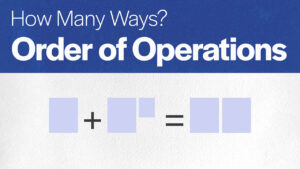
How Many Ways: Order of Operations 1
How many different ways can you make this math statement true using only the digits one through nine?

Advanced Alliteration and Consonance
When students learn about alliteration, it’s hard to steer them away from goofy tongue-twisters. Certainly, there must be more powerful and practical ways of using alliteration. In this lesson, I draw on delicious examples from Shakespeare to show how a very advanced writer used alliteration. Then, I break those ideas down so students can try them out.

Undoing Multiplication With Division
Multiplication and division, natural foes, are constantly seeking to undo each other. Students will attempt to reverse the effects of multiplication by dividing once, twice, or even thrice!

Exponents – How Low Can They Go?
Using exponent patterns, can students predict what the 0th power will be?

Finding The Volume of Laptops
How has the volume of laptops changed over time? You know you want to check out how huge those first versions were!

Math Curiosity: Primes and Squares
Can any perfect square be written as the sum of two primes?

What Do Mean and Median Mean?
When will mean and median give us different results?

Depth and Complexity: 👓 Multiple Perspectives
Every topic looks different depending on who’s looking. This prompt teaches students to see through someone else’s eyes.

Percents and Credit Cards
Let’s buy something expensive with a credit card and then make only the minumum payments!

A Nutrition-Based Math Project
Let’s create a parody ad attacking a surprisingly calorie-rich meal.

Fancier Figurative Language: Start with a Cliche
We’ll start with the cliché “as cold as ice” and go somewhere much more interesting.