


Playlist: Bookmarks

Student Introductions With Depth, Complexity, and Frames: Level Two
Once students know the prompts of Depth and Complexity, let’s take them much higher up Bloom’s Taxonomy.

Phrases to Join a Discussion
Want your classroom discussions to go a bit more smoothly? Train students to use a few simple phrases and it’ll make all the difference in the world.

From “Identify” to “Analyze” – Famous Structures
For TeachersRather than just learning about one structure, let’s climb Bloom’s and think more deeply.

Not Like The Others: US National Parks
Four US national parks. One doesn’t belong. But which one? That depends on your argument.

Introducing Universal Theme of Conflict
So what could you do with a Universal Theme of Conflict? Well, here’s an introduction that will get your students’ brains sweating.

Introducing Universal Theme of Change
Everything changes. But how does it change? Students brainstorm dozens of examples and boil them down to one big idea.
Brain Needs or Heart Needs
For TeachersWe think of gifted kids as only having academic needs, but – in their own words – they also have many needs of the heart.

Invisible Power Can Have Visible Effects
Can you think of times when power is unseen, but we can clearly see its effects?

SCAMPER: Scaffolding Creativity
Asking students to “think creatively” won’t get you far. They won’t know how to start, they’ll get stuck with simple ideas, or they’ll just go completely wild. SCAMPER is a tool for scaffolding the process of creativity.

Depth and Complexity – An Introduction for Teachers
For TeachersDepth and Complexity is the most powerful framework most teachers have never heard of. Here’s what it actually is — and isn’t.

More Specific than “Smart”
When students are told that they’re “smart”, what does this word actually mean to them? (Psst. It isn’t what we intended.)
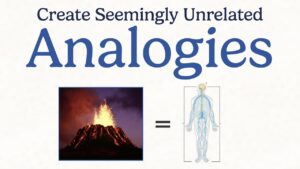
Building Creative Analogies
We’ll take two seemingly unrelated pieces of content (say volcanoes and the human body) and then build analogies to connect the two ideas. In the end, students can create a skit, comic, or story relating the two concepts.

Depth and Complexity: 📈 Trends
Has something been changing recently? What might be causing that? What are the effects?

Depth and Complexity: 👄 Language of the Discipline
Imagine a construction worker who doesn’t know the name of a screwdriver or a doctor who can’t remember what to call your neck. It’s pretty hard to communicate well without knowing the 👄 Language of the Discipline!

Depth and Complexity: ❓ Unanswered Questions
This underutilized tool focuses students on what we don’t yet know and even what we can’t know.

Depth and Complexity: ⚖️ Ethics
Want to add drama to any topic? Use the Ethics prompt!

Depth and Complexity: 🚦 Rules
Is there a consequence for not doing something? You may have found a rule!

Depth and Complexity: 🏛️ Big Idea
Let’s get students thinking big and focusing on more abstract ideas.

Depth and Complexity: 📚 Across Disciplines
No topic is an island! With the 📚 Across Disciplines prompt, students note connections within and across multiple fields.

Depth and Complexity: ⏳ Change Over Time
Want to get students thinking about how a topic has changed or might change in the future? The ⏳ Change Over Time thinking tool is just what you need!

Depth and Complexity: 👓 Multiple Perspectives
Every topic looks different depending on who’s looking. This prompt teaches students to see through someone else’s eyes.

Depth and Complexity: Patterns
Can your students spot anything that repeats? Or that has stopped repeating?

Depth and Complexity: 🌻 Details
Get kids focusing on the small, but essential, details of a topic.

Ethics In The Young Elementary Classroom
For TeachersCan kindergartners discuss ethical issues? Yes. Here’s how to weave multiple-perspective problems throughout your curriculum.