Grade 6
-
Expressions & Equations
-
Geometry
-
The Number System
-
Ratios & Proportional Relationships
-
Statistics & Probability
CCSS Math Standard: 6.NS.1
Apply and extend previous understandings of multiplication and division to divide fractions by fractions. Interpret and compute quotients of fractions, and solve word problems involving division of fractions by fractions, e.g., by using visual fraction models and equations to represent the problem. For example, create a story context for (2/3) ÷ (3/4) and use a visual fraction model to show the quotient; use the relationship between multiplication and division to explain that (2/3) ÷ (3/4) = 8/9 because 3/4 of 8/9 is 2/3. (In general, (a/b) ÷ (c/d) = ad/bc.) How much chocolate will each person get if 3 people share 1/2 lb of chocolate equally? How many 3/4-cup servings are in 2/3 of a cup of yogurt? How wide is a rectangular strip of land with length 3/4 mi and area 1/2 square mi?
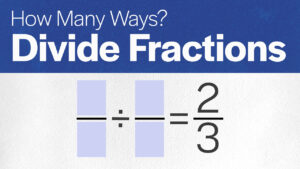
How Many Ways: Fractions Divide Equals 2/3
One equation. Digits one through nine. How many ways can you make it work?
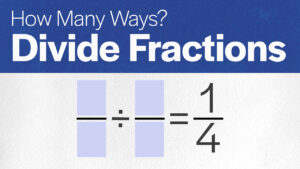
How Many Ways: Divide Fractions Equal 1/4
How many different ways can you make this fraction division math statement true using only the digits one through nine?

Numerator or Denominator: Which has more power in a fraction?
What do you do with students who already get their fraction operations? Give them a contrived project about recipes or pizza slices? Make them solve annoyingly hard practice problems? Please. Here, we get students thinking in a whole new way, pondering which has more power, the numerator or denominator.

A Visual Guide To Dividing By Fractions
Have you ever wondered what it looks like to divide by a fraction, man?